I am at the Oakland Arena. Sunday night is settling over the San Francisco Bay Area. I came here expecting my people, the Gen-Xers, looking for a room filled with silver-haired folks who carry the old days folded in their back pockets. But the room has a different vibe. There’s a fair number of youth mixing with the middle-aged, drawn together by the deep, undeniable pull of a shared root, and a shared soil.
Last year, I sat in this arena to watch A.R. Rahman tear the roof off the night. But tonight, the air is thick with a different kind of weather. The mood is mellower. Heavy with sweet nostalgia. We are not here for a spectacle. Tonight is a homage to a maestro who has spent fifty years laying down the very tracks of our lives.
And then, he walked out on the stage. The entire arena rose as one. A roaring, breathless standing ovation for the man.
Isaignani Ilaiyaraaja.
The Harmonium and the Tsunami
Watching him on stage, under the lights, it was poignant to hear him speak of the beginning. Long before he was the maestro who built the emotional architecture of our lives – the rooms in our hearts and the foundations of our memories , there was just a boy in the village of Pannaipuram. He spoke of his early days, of a fierce, almost monastic devotion, of wanting to know the wood and wind of the harmonium better than the beat of his own heart.
Where others were simply content to let the world pass by, he took inventory of the earth itself. The folk songs, and the temple bells, and the ancient rhythms humming right beneath the red dirt. He went down into the caverns of the craft, studying the grammar of Western classical notes, counting the beats of counterpoint, mastering the ink of notation until he knew it intimately.
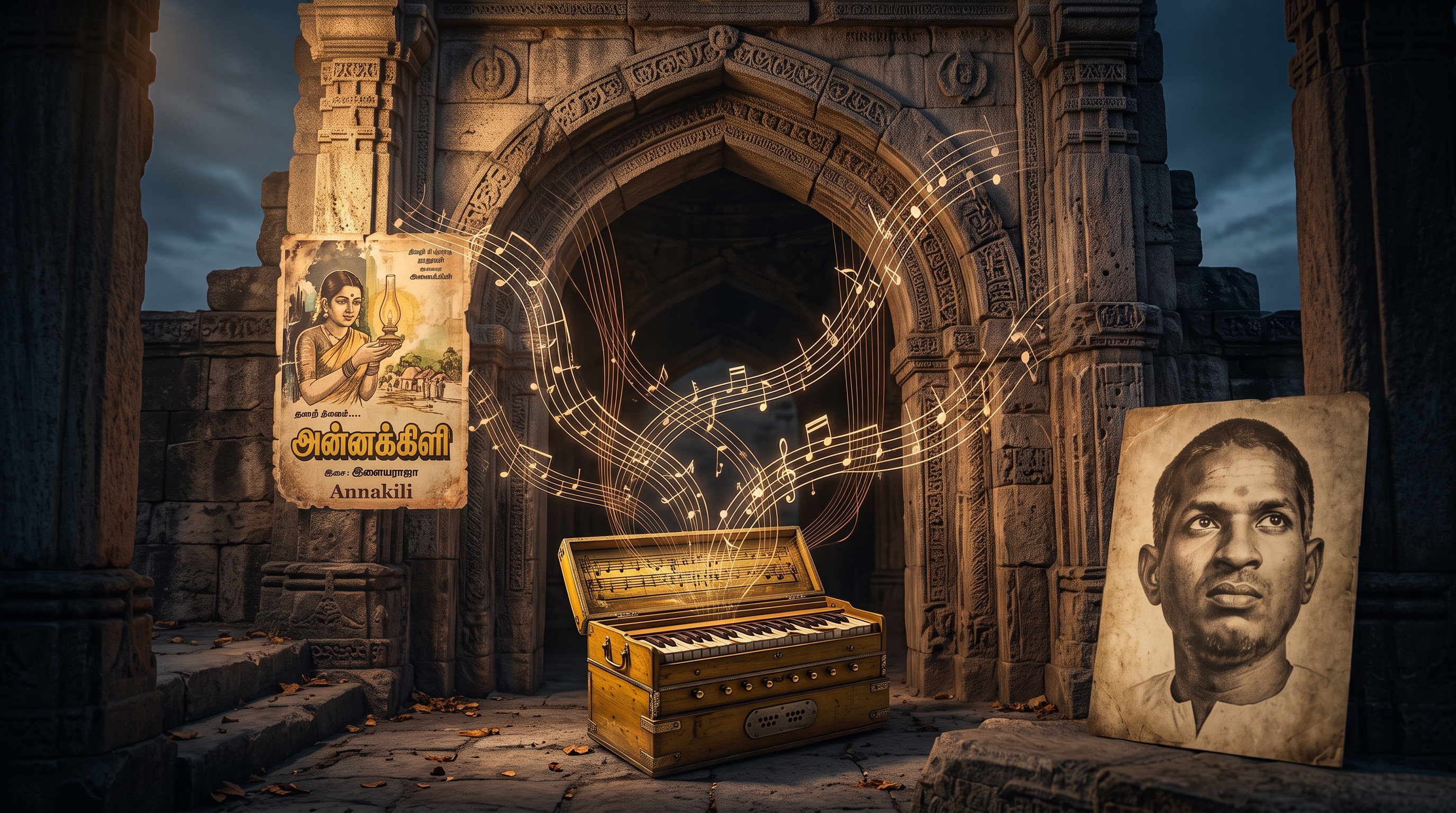
When his first break arrived in 1976 with Annakili, it did not merely announce a new music composer. It unleashed a tsunami. He took the raw, untamed mud of the village and married it to the wide, arched ceilings of the symphony. Annakili swept the state of Tamil Nadu. It rushed through the streets, the tea shops, and the radios like a sudden, glorious and wet rain. A star was born. When raw, rustic passion takes a rigorous vow to the discipline of learning. something holy happens. Suddenly, the rural Tamil soil and European strings were speaking the same tongue.
There are sounds that merely fill the air, and then there is what Ilaiyaraja does. For fifty golden years of sunlight and rain, his melodies have been the faithful companions to my deepest sorrows, my quietest joys, and everything in the long stretch between being young and being on that runway to old age and oblivion I find myself today. I didn’t know that letting a ‘Raja Sir’ composition take hold of me was to surrender to a memory I held in my veins.
Here’s a tribute to a few of my favorite songs. I could easily write a hundred of these.
Poove Sempoove
Listening to this song today at my age and where I find myself in life, I feel the shivering fragility of a midnight heartbreak. The song does not demand your attention. No. Instead, it washes over you like a warm and gentle tide. The electric hum of the modern instruments, the gentle finger picking of an acoustic guitar, married to the aching breath of a flute build a space as vast as the night sky and as intimate as the stars. Anchored by K.J. Yesudas’s velvety voice – sounding like dark honey and old wood – the melody slithers right past your defenses. It promises a profound, settling peace and yet leaves an unmistakable pang of a heavy, unsaid grief in the heart. The words do not layer on top of the music. They melt right into it. It is a song that calls up the ghosts of regrets, and the sweet sting of goodbyes. It’s a masterclass in subtlety. For those hours when the world is quiet, and you just want to sit in the silence and let the music do the weeping for you.
Rasathi Unna
If Poove Sempoove is a quiet night under starry skies, then Rasathi Unna is the sun-baked red dirt of a village road. It strips away every ounce of studio sheen to hand you something undeniably primal, rustic, and bleeding. A solitary, mournful string and the steady, thudding heartbeat of a hide drum carry all the emotional weight. And when P. Jayachandran’s voice enters the air, it sounds bone-tired, broken open, and utterly honest. It’s the voice of a man who has lived through a loss, singing his grief out to the empty fields. It is desperate and earthy, a plea to a beloved, stripped of prettiness, and adorned only by the raw dialect of an ordinary man nursing an inconsolable sorrow.
Ilaya Nila
Then there is the irrepressible strut of Ilaya Nila. A track that bustles with a wholly different kind of fire. Right out of the gate, it grabs you with a galloping electric guitar, strummed by hands that know the secrets of the string and the fret. Ilaiyaraja performs a kind of magic here, taking the deep, walking stride of a jazz bassline and fusing it with the rhythms of the old melodies we carry in our bloodlines. A sound that chugs along splendidly, forward and unbothered. Floating above it all is SPB. His vocals smooth, satisfied, alive with the reckless, arrogant beauty of being young, summoning the gorgeous, foolish optimism of a misspent youth. It sounded perfect to me as a college boy. And it sounds perfect to me now.
Inraikku En Indha Anandhamey
Imagine sunshine being reborn as music. The song bursts forth like the sun coming out from behind the clouds after a long drought. A dizzying rush of joy, set in Abhogi ragam, driven by bright rhythms that catch you unawares and carry your stumbling heart into unexpected grace.
Janani Janani
And then, there is Janani Janani.
This is the song Ilayaraja was born to compose. It is the song he was born to sing. If his body of work is a sprawling country, this song is the quiet, beating heart at its center. It feels less composed and more like a prayer. Stripped of all vanity, it is a profound exploration of devotion and life itself. In its haunting, deeply spiritual resonance, Janani Janani holds Ilaiyaraja’s soul. His capacity for faith and a reverence for the life force that music provides.
The Echoes We Carry
Raja gives us this world. And he makes us want to give it back. His songs make us want to sing them aloud. Never mind that the throat catches, that there is no way on God’s green earth we can scale those high notes only SPB or Chitra could summon with such ease. We pull the melodies toward us anyway, demanding they be shared with our favorite people. Whether on late-night car rides under amber streetlights or with family in the living room.
Because singing together, even with a cracked voice and the missing note, is one of the purest ways we can tell someone how much they mean to us. Singing carries no pretense and needs no justification. It is a way of saying: Here I am. My voice may be imperfect, but my affection for you is not. Music is a language stripped bare, a way of stepping outside ourselves to prove that art and beauty are larger than our mundane burdens, a pure, uncomplicated gift that we hand back and forth in the light of our love.
The Journey Continues
Today, at eighty-two years old, the maestro remains a force of nature. Fifty years behind him, an entire universe created, and he is still writing, composing and singing. The river keeps moving, deep and unbothered by time.
Thank you, Raja Sir. For building the house. For giving our souls a language they can understand. Here’s to the next 50 years.
Leave a Reply