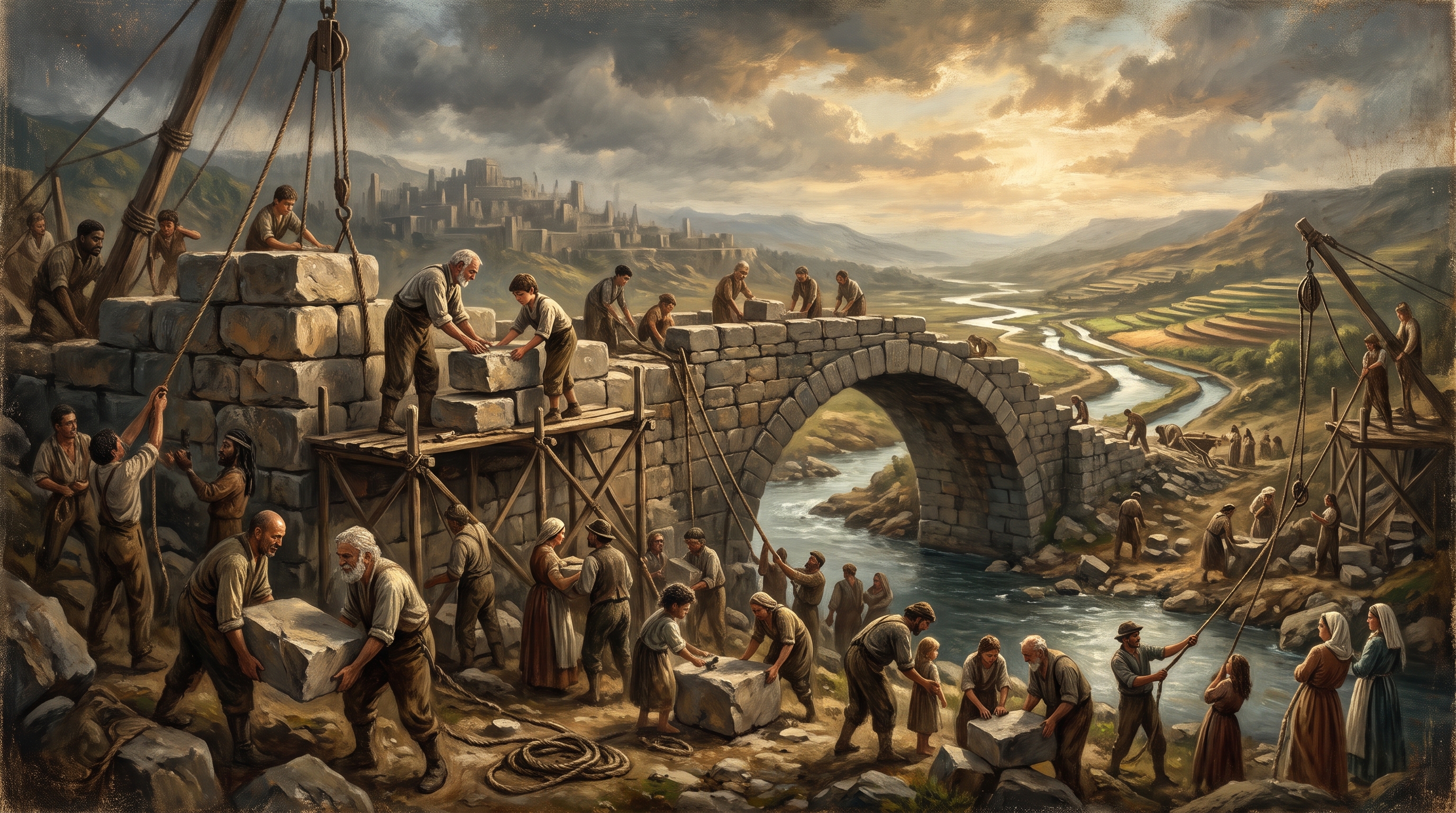
Suppose we were asked to draft the blueprint for a new civilization. Even before the first line is drawn, there is a sense of the thing beginning to unravel.
No one should take on a task of that magnitude without first understanding its terms, and the terms are fatalistic. We want to build something that lasts, something that can stand through hard winters, dry winds and the slow grinding of the earth beneath it, a place where a child might grow up safely and grow old. But every builder has to assume entropy. Whatever we make will harden over time. Its machinery will one day exist mostly to keep itself running, and the gathering weight of its own complexity will, in the end, pull it under.
This is not pessimism. It is simply the nature of things. Decay is not ours to prevent. What we can decide is how long the structure stands, and how well it shelters the people inside it while it does.
Seen that way, a civilization cannot rest on intelligence, or wealth, or the luck of its geography. Those are conditions, like weather. The one foundation that bears the load, the thing that keeps the whole structure from sliding off the hillside, is trust.
Trust is a strange and delicate material. It is not an abstract virtue but a working tether, invisible and yet real. It is what keeps the driver in the oncoming lane from drifting into yours. It is the unspoken certainty that the water from the tap is safe, that the money in your pocket will be worth tomorrow what it is worth today, and that the story a civilization tells about itself, however embellished, still holds together. Where it exists, there is bedrock, ground firm enough to build on.
Where it is absent, a different structure rises: the architecture of fear. Neighborhoods wall themselves in. Public squares become private property. People hoard gold, weapons, canned food and water, because the tether has broken and they have concluded that no one is coming for them.
Trust cannot be ordered into being. It has to be grown, and what a society can do is tend the soil. That means rules that bind those who write the laws as firmly as those who sweep the floors. It means water that reaches the last field at the end of the canal, and hard years whose losses are carried by everyone. When the soil is right, the rewards arrive quickly and with a certain dream-like beauty. People stop guarding the walls. They trade, invent, build bridges and roads, paint and compose. They begin to look outward.
History offers moments when the foundation held. In the early Roman Republic, Cincinnatus was handed absolute power in a crisis, used it, then gave it back and went home to plow his fields, because he trusted the institutions more than his own ambition. Venice raised a maritime empire out of the mud of a lagoon on the strength of the Colleganza, a contract in which the merchant who supplied the money and the sailor who supplied the nerve shared both the danger and the profit. For as long as the risk was shared, the city thrived. Then, in 1297, the Great Council closed its membership to every family not already seated there, an act the Venetians called the Serrata, the locking. Once the aristocracy stopped sharing the risk, trust drained away over the centuries that followed, and the city slowly became what it is today: a beautiful, sinking museum.
America had that kind of trust for a while.
In the years after the Second World War, the country ran on a remarkably unified story. A shared ordeal had produced a shared sense of reality. It showed in the assembly lines and shipyards, in the GI Bill, in the new suburbs spreading across former farmland. The prosperity was enormous, and so was the unwritten social contract beneath it. People believed what they read in the newspaper and heard on the evening broadcast. They believed the system, for all its flaws, could correct itself. The trust even took physical form: highways, dams, steel mills, and rockets aimed at the moon.
But we must be honest about who was allowed to stand on that foundation. Many of those new suburbs were drawn with red lines around them, and the promise of the GI Bill reached Black veterans slowly, when it reached them at all. The trust was real, but it was rationed. That is not a footnote to the argument. It is the argument. Where risk and reward were shared, the tether held. Where they were not, it never formed. Racism ran beneath that foundation like a fault line, and it kept trust from ever reaching everyone. That has always been the original fault of America.
Then the cracks widened.
No single moment marks the break, but the sequence is easy to follow. The assassinations, Vietnam and Watergate were the first tremors. The deeper fracture was economic, and it happened out of sight, in boardrooms and on trading floors. Risk stopped being shared. A country that made things became a country that traded in abstractions. We stopped building dams and started building derivatives.
The people making decisions were no longer the people living with their consequences. Factories emptied, capital gathered on the coasts, and the tether snapped. The middle class felt the floor giving way beneath it, and those at the top seemed not to notice, having long since installed floors of their own.
A great society produces great rewards, and everyone who helped produce them has a claim on them, if not an equal one. Not everyone is born with the cleverness and cunning that lead to fortune. Some contribute their labor. Some contribute little more than the persistence to show up each morning, which has always been enough to build a nation on. A society that rewards only those who work the numbers and forgets those simply trying to make it to sunset has broken the bargain. That is what happened. Entropy was always coming. These choices invited it in early.
Now the air carries a kind of low fever. The intelligence, the wealth and the natural advantages remain, but the foundation is nearly gone. Fear has become the ordinary condition. We no longer share an epistemology, which is to say we no longer agree on what is real. Culture has become less a common experience than an exhausting, endless argument. Politics has turned from the work of governing into the airing of grievances, a spectacle staged for millions too numb to look away. Society is a crowd of strangers in separate rooms, each looking at a screen, each certain that half the country means them ill.
Into this fever we now introduce artificial intelligence.
The psychological toll this will place on us is hard to overstate. A civilization that has already lost its hold on shared reality is meeting a technology that manufactures the synthetic at scale. The early forms are already here: the cloned voice of a grandchild on the phone, pleading for bail money; the fabricated clip of a politician that spreads for a day before anyone thinks to doubt it. AI does more than blur the line between true and false. It threatens to make the line itself seem irrelevant. You will not always know whether the video in front of you, the voice on the line or the outrage in your feed came from a person or from a model running in a data center.
The likely result is a certain kind of nihilism. When anything can be faked, people stop caring what is real, and something in them goes flat. Lacking trust, we will try to replace it with verification: elaborate, cumbersome systems to authenticate every exchange, a defensive architecture of watermarks and accounting that will slow the culture to a crawl. But verification is not trust. It is trust’s opposite, the institutional management of suspicion. And a society that runs on paranoia becomes spiritually exhausted to its core.
Where does that leave us?
Divided, and not only along the familiar lines. The deepest divide now runs between generations.
The young see plainly what their elders cannot bring themselves to say: the structure we have now will not hold. They were born after the tether snapped. They have never known the floor to be solid, never quite believed the evening broadcast, never assumed that reward would follow work. To them the old arrangement is not a home in need of repair but a ruin they are being asked to pay rent on. And they understand, perhaps better than anyone, that no one can download a glass of water.
The old see something else. They remember when the foundation held, and they are clinging to what is left of it with everything they have, because letting go would mean admitting it is gone. So, a tug of war is under way, one side straining to preserve the structure, the other ready to clear the ground. Contests like this are won by energy rather than nostalgia, and energy belongs to the young. The outcome is not really in doubt.
They will take the reins. Not all of them will be what the moment calls for. Every generation produces as many charlatans as it does sincere builders, and the young are no exception. No upheaval offers a clean exit, free of con men and the power-hungry. But they must be allowed to do what they must do to rebuild the foundation, or the ship goes down with all of us aboard.
What the old owe them, then, is not resistance but labor. We should offer our shoulders and our hands, and help them build in the manner they choose, not the one we would have chosen. The future belongs to them, not to us. It is the penance we owe for bringing things to this point.
And when they finally walk through the doors of power, they will find themselves where this great experiment began: in front of a blank page, facing the original question. What is the blueprint of a great society? The answer will be what it has always been. Not more intelligence, more wealth or better land. Rules that bind the people who write them as tightly as the people who sweep the floors. Water that flows through to the last field at the end of the canal. Bad years whose burdens are shared by all, and good years whose rewards are shared as well. It will not last forever. Nothing does. But built that way, it just might last long enough for a child to grow up inside it, and to grow old.
Leave a Reply