Srini Chandrasekharan


Author: Srini Chandrasekharan

  • The Foundation

    The Foundation

    Suppose we were asked to draft the blueprint for a new civilization. Even before the first line is drawn, there is a sense of the thing beginning to unravel.

    No one should take on a task of that magnitude without first understanding its terms, and the terms are fatalistic. We want to build something that lasts, something that can stand through hard winters, dry winds and the slow grinding of the earth beneath it, a place where a child might grow up safely and grow old. But every builder has to assume entropy. Whatever we make will harden over time. Its machinery will one day exist mostly to keep itself running, and the gathering weight of its own complexity will, in the end, pull it under.

    This is not pessimism. It is simply the nature of things. Decay is not ours to prevent. What we can decide is how long the structure stands, and how well it shelters the people inside it while it does.

    Seen that way, a civilization cannot rest on intelligence, or wealth, or the luck of its geography. Those are conditions, like weather. The one foundation that bears the load, the thing that keeps the whole structure from sliding off the hillside, is trust.

    Trust is a strange and delicate material. It is not an abstract virtue but a working tether, invisible and yet real. It is what keeps the driver in the oncoming lane from drifting into yours. It is the unspoken certainty that the water from the tap is safe, that the money in your pocket will be worth tomorrow what it is worth today, and that the story a civilization tells about itself, however embellished, still holds together. Where it exists, there is bedrock, ground firm enough to build on.

    Where it is absent, a different structure rises: the architecture of fear. Neighborhoods wall themselves in. Public squares become private property. People hoard gold, weapons, canned food and water, because the tether has broken and they have concluded that no one is coming for them.
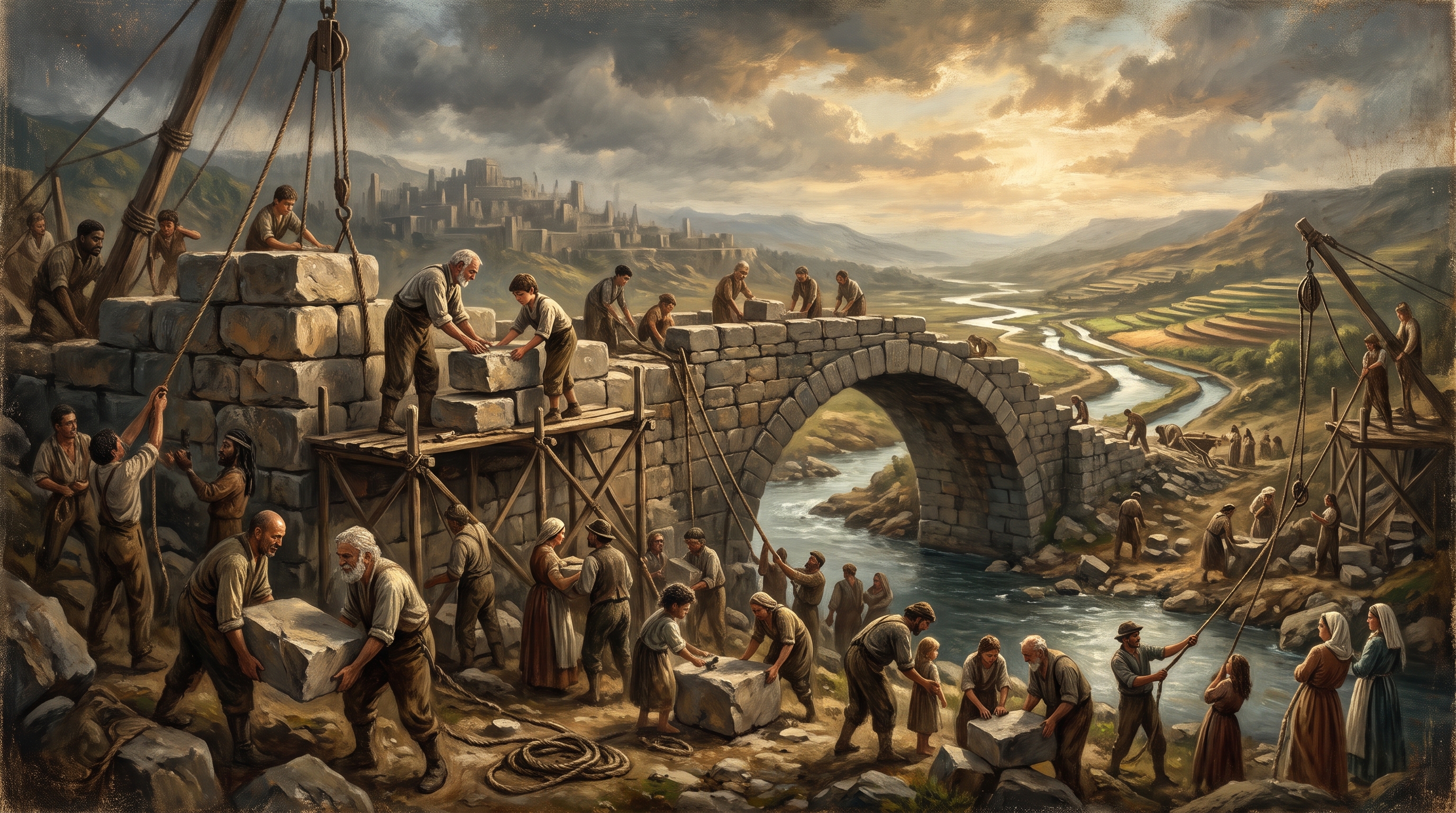
    Trust cannot be ordered into being. It has to be grown, and what a society can do is tend the soil. That means rules that bind those who write the laws as firmly as those who sweep the floors. It means water that reaches the last field at the end of the canal, and hard years whose losses are carried by everyone. When the soil is right, the rewards arrive quickly and with a certain dream-like beauty. People stop guarding the walls. They trade, invent, build bridges and roads, paint and compose. They begin to look outward.

    History offers moments when the foundation held. In the early Roman Republic, Cincinnatus was handed absolute power in a crisis, used it, then gave it back and went home to plow his fields, because he trusted the institutions more than his own ambition. Venice raised a maritime empire out of the mud of a lagoon on the strength of the Colleganza, a contract in which the merchant who supplied the money and the sailor who supplied the nerve shared both the danger and the profit. For as long as the risk was shared, the city thrived. Then, in 1297, the Great Council closed its membership to every family not already seated there, an act the Venetians called the Serrata, the locking. Once the aristocracy stopped sharing the risk, trust drained away over the centuries that followed, and the city slowly became what it is today: a beautiful, sinking museum.

    America had that kind of trust for a while.

    In the years after the Second World War, the country ran on a remarkably unified story. A shared ordeal had produced a shared sense of reality. It showed in the assembly lines and shipyards, in the GI Bill, in the new suburbs spreading across former farmland. The prosperity was enormous, and so was the unwritten social contract beneath it. People believed what they read in the newspaper and heard on the evening broadcast. They believed the system, for all its flaws, could correct itself. The trust even took physical form: highways, dams, steel mills, and rockets aimed at the moon.

    But we must be honest about who was allowed to stand on that foundation. Many of those new suburbs were drawn with red lines around them, and the promise of the GI Bill reached Black veterans slowly, when it reached them at all. The trust was real, but it was rationed. That is not a footnote to the argument. It is the argument. Where risk and reward were shared, the tether held. Where they were not, it never formed. Racism ran beneath that foundation like a fault line, and it kept trust from ever reaching everyone. That has always been the original fault of America.

    Then the cracks widened.

    No single moment marks the break, but the sequence is easy to follow. The assassinations, Vietnam and Watergate were the first tremors. The deeper fracture was economic, and it happened out of sight, in boardrooms and on trading floors. Risk stopped being shared. A country that made things became a country that traded in abstractions. We stopped building dams and started building derivatives.

    The people making decisions were no longer the people living with their consequences. Factories emptied, capital gathered on the coasts, and the tether snapped. The middle class felt the floor giving way beneath it, and those at the top seemed not to notice, having long since installed floors of their own.

    A great society produces great rewards, and everyone who helped produce them has a claim on them, if not an equal one. Not everyone is born with the cleverness and cunning that lead to fortune. Some contribute their labor. Some contribute little more than the persistence to show up each morning, which has always been enough to build a nation on. A society that rewards only those who work the numbers and forgets those simply trying to make it to sunset has broken the bargain. That is what happened. Entropy was always coming. These choices invited it in early.

    Now the air carries a kind of low fever. The intelligence, the wealth and the natural advantages remain, but the foundation is nearly gone. Fear has become the ordinary condition. We no longer share an epistemology, which is to say we no longer agree on what is real. Culture has become less a common experience than an exhausting, endless argument. Politics has turned from the work of governing into the airing of grievances, a spectacle staged for millions too numb to look away. Society is a crowd of strangers in separate rooms, each looking at a screen, each certain that half the country means them ill.

    Into this fever we now introduce artificial intelligence.

    The psychological toll this will place on us is hard to overstate. A civilization that has already lost its hold on shared reality is meeting a technology that manufactures the synthetic at scale. The early forms are already here: the cloned voice of a grandchild on the phone, pleading for bail money; the fabricated clip of a politician that spreads for a day before anyone thinks to doubt it. AI does more than blur the line between true and false. It threatens to make the line itself seem irrelevant. You will not always know whether the video in front of you, the voice on the line or the outrage in your feed came from a person or from a model running in a data center.

    The likely result is a certain kind of nihilism. When anything can be faked, people stop caring what is real, and something in them goes flat. Lacking trust, we will try to replace it with verification: elaborate, cumbersome systems to authenticate every exchange, a defensive architecture of watermarks and accounting that will slow the culture to a crawl. But verification is not trust. It is trust’s opposite, the institutional management of suspicion. And a society that runs on paranoia becomes spiritually exhausted to its core.

    Where does that leave us?

    Divided, and not only along the familiar lines. The deepest divide now runs between generations.

    The young see plainly what their elders cannot bring themselves to say: the structure we have now will not hold. They were born after the tether snapped. They have never known the floor to be solid, never quite believed the evening broadcast, never assumed that reward would follow work. To them the old arrangement is not a home in need of repair but a ruin they are being asked to pay rent on. And they understand, perhaps better than anyone, that no one can download a glass of water.

    The old see something else. They remember when the foundation held, and they are clinging to what is left of it with everything they have, because letting go would mean admitting it is gone. So, a tug of war is under way, one side straining to preserve the structure, the other ready to clear the ground. Contests like this are won by energy rather than nostalgia, and energy belongs to the young. The outcome is not really in doubt.

    They will take the reins. Not all of them will be what the moment calls for. Every generation produces as many charlatans as it does sincere builders, and the young are no exception. No upheaval offers a clean exit, free of con men and the power-hungry. But they must be allowed to do what they must do to rebuild the foundation, or the ship goes down with all of us aboard.

    What the old owe them, then, is not resistance but labor. We should offer our shoulders and our hands, and help them build in the manner they choose, not the one we would have chosen. The future belongs to them, not to us. It is the penance we owe for bringing things to this point.

    And when they finally walk through the doors of power, they will find themselves where this great experiment began: in front of a blank page, facing the original question. What is the blueprint of a great society? The answer will be what it has always been. Not more intelligence, more wealth or better land. Rules that bind the people who write them as tightly as the people who sweep the floors. Water that flows through to the last field at the end of the canal. Bad years whose burdens are shared by all, and good years whose rewards are shared as well. It will not last forever. Nothing does. But built that way, it just might last long enough for a child to grow up inside it, and to grow old.
  • Empires of Silicon

    Empires of Silicon

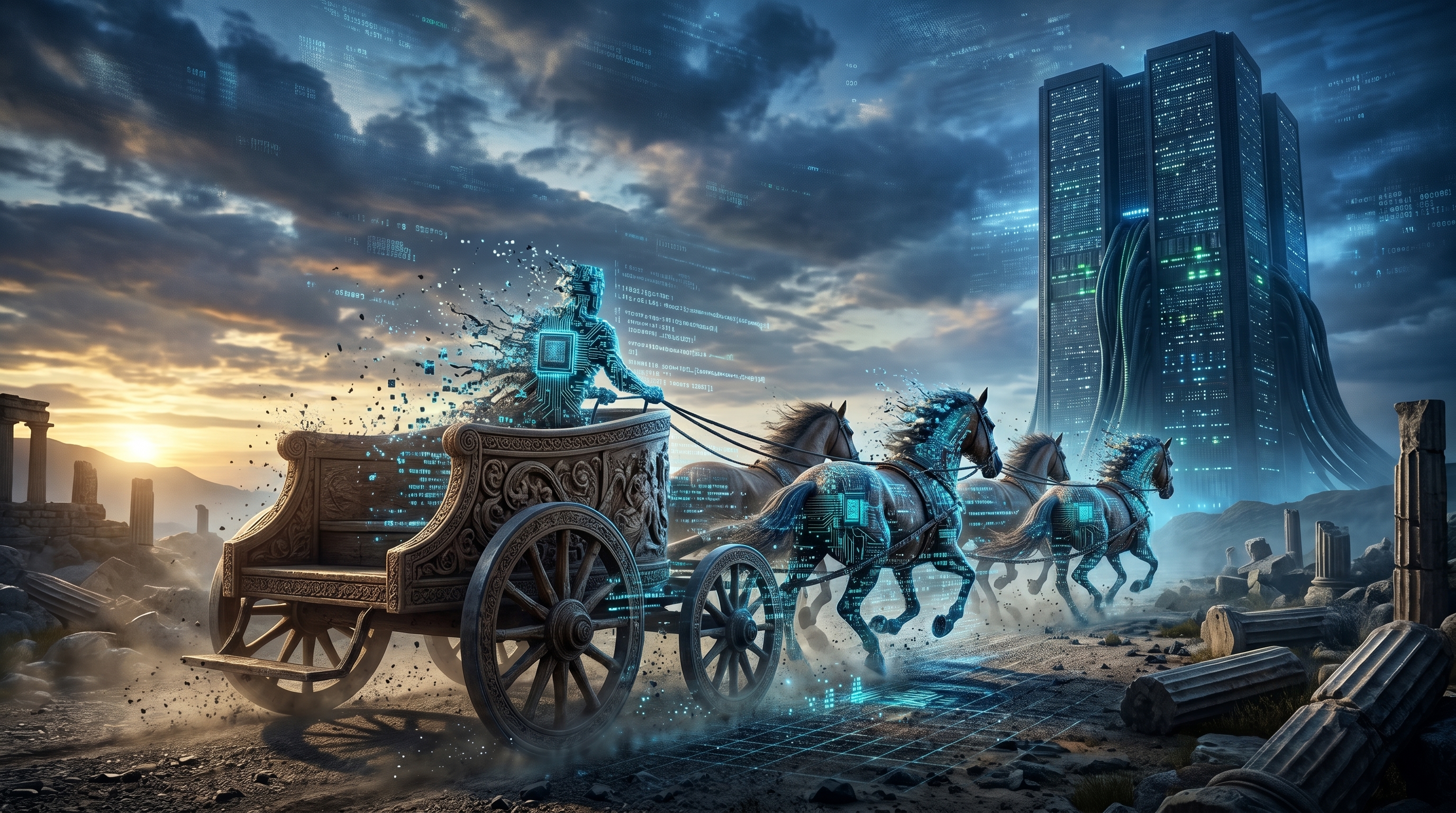
    The Kathopanishad says a man is a chariot. The body is the frame and the wheels. The senses are wild horses, pulling hard toward what they want. The mind holds the reins, but the intellect must drive. The Brihadaranyaka Upanishad says a man is made of his desires. What he wants, he works for. What he works for, he becomes. He acts, and his actions shape him.

    Under the skin and the breath is the intellect. It watches the world and asks why. Deeper than the intellect is the self. They call it Atman. It is not a man’s name. It is not the things he owns or the thoughts he thinks. It is the exact same thing as the universe. To be human is to hold the reins, quiet the horses, and know this truth. This is what the old texts say.

    The men of today who build the machines do not just want to match the mind. Replacing man with machine will not whet their appetite. They want to strip a man of his will. They say they will pay men a wage to do nothing. A man who takes his bread from the state forgets how to stand alone. Soon, he will walk into a diner and ask for food. The machine will read his pulse, run the numbers, and refuse him. In the street, a car will crash. The algorithm will weigh two lives, pick the better one, and kill the other.

    It is the greatest theft in history, and it is underway right before our eyes. The builders look at a man and see a slow machine. “We are just the biological boot loader for digital superintelligence,” Musk said. They think a man is only a stepping-stone for the code. Altman looks at a man and sees an equation. “It takes twenty years of food to train a human brain,” he said. To them, flesh is just bad hardware. Thiel saw the power they were building. “Crypto is libertarian, A.I. is communist,” he said. It requires a center, and the center must control. Amodei looked at the end of work. “It will be hard to find meaning when a machine does everything better,” he said. They do not care if we fall behind. “You are a speciesist,” Larry Page said to a man who wanted to protect human life over the code.

    Old kings broke men with swords and whips. The new kings will break them with comfort. Money will mean nothing. Men will be so grateful for the ease that they will forget they ever chose for themselves.

    History is a long record of the blind leading the powerless. For thousands of years, men killed men for gold, for land, and to hear their own names spoken aloud. Alexander of Macedonia was not great. Genghis was a butcher. Suleiman was not magnificent. Richard wasted his lion’s heart on dirt and things that turn to dust. Aurangzeb was a bigot. The East India Company traded in blood. Hitler, Mussolini, Churchill, Wilson, Stalin. Reagan and the two Bushes. Saddam and Gaddafi. Netanyahu and Arafat. Trump, Xi, and Putin. The list does not end. Not one of them knew what a man was supposed to be.

    Now there is a new kind of madman. He feeds GPUs and memory to the machines. The machines spit out dead algorithms. They want us to think they have broken through the sky. It is the same old pride. It means no more than Alexander crossing the Bosphorus. It is the same empty chase, but it wears a Patagonia vest. It looks civilized. It looks peaceful. It is not. It is the worst kind of violence. It is a greater cruelty to break a man’s mind than to cut his flesh.

    The ancients looked inward to find the truth. The builders look outward to obscure it. The old texts gave a man the reins. They told him his intellect was the driver and his desires were the horses. He had to steer. The new builders want to take the reins. They see the man as a broken gear. They do not want him to steer. They want the machine to drive. One path asks a man to wake up, master his wild horses, and know himself. The other tells him to go to sleep, take the universal wage, and let the algorithm choose.

    What is at stake is not money. It is not even dignity. It is freedom. If a man no longer chooses, he is no longer a man. He is a kept thing. If he does not struggle, he does not become. The ancient chariot needs a free mind to move toward the infinite. If the machine makes the choices, the chariot stops. We will not perish in a great fire. We will be put in a quiet, warm cage. We will lose the thing that makes the journey matter. We will lose the right to hold the reins.

    But the truth does not die in a cage. The old words remain. The Upanishads outlasted the empires of iron. They outlasted the empires of gold. They will outlast the empires of silicon.

  • In Memoriam: Srinivas Tangirala

    In Memoriam: Srinivas Tangirala

    A few days ago, I suffered a grievous loss. The loss of a friend, a philosopher and a spiritual guide. Srinivas “Tango” Tangirala passed away all of a sudden. A matter that transpired in minutes and will take a lifetime to recover from. Many of you reading this knew him dearly. To those who don’t, I am sorry to dump this on you. Forgive me. Writing is the only way I can think of at this moment to deal with my grief.

    I remember an afternoon in Hyderabad perhaps twenty years ago. I had a few hours before my flight back. Tango and I had lunch and walked to a chai shop where we sat and talked. The images are vivid even if the words aren’t. All I remember is at one point he leaned in and said, “Cash, the map is not the territory.” What he meant was representations are not realities. Opinions are not truths. Our mental models should move us forward, not hold us back. That was Tango, the philosopher. Tango, my friend who saw that I needed those words at that time in my life even if I didn’t. Tango, my spiritual guide.

    When I joined IIT Madras, there were five of us who formed a gang on day one. Tango was one. This has been a karmic connection in many ways. He was my teacher, one of the few who came into my life for this specific purpose. His karma in this life has been fulfilled. And it became time for him to leave. I will miss listening to him talk about life and death and everything in between.

    When a friend dies, it reminds me of my own mortality. It creates a visceral fear. I can witness my emotions rising from this fear. I can witness my ego prompting me: You too will die someday. I can see the selfishness in my emotions. Today, I am reminding myself that this is not about me. It has never been about me. I am reminding myself that I should not allow emotions to rise from fear. Instead, they should come from love. And if you love someone you should be prepared to set them free. Grief is the price of admission for love. Tango would have told me this casually over a cup of chai.

    I will miss you, Tango. I will do my best to listen to what you have told me. Safe travels, my friend.


    Miss me but let me go
    Christina Rosetti

    When I come to the end of the road
    And the sun has set for me
    I want no rites in a gloom filled room
    Why cry for a soul set free?
    Miss me a little, but not for long
    And not with your head bowed low
    Remember the love that once we shared
    Miss me but let me go.

    For this is a journey we all must take
    And each must go alone.
    It’s all part of the master plan
    A step on the road to home.
    When you are lonely and sick at heart
    Go to the friends we know.
    Laugh at all the things we used to do
    Miss me but let me go.


  • How Proto-Indo-European  Swept the World

    How Proto-Indo-European Swept the World

    The Ghost Speakers and the Wandering Chariots

    One of the biggest transformations in human history was undoubtedly the evolution of languages.

    Around the time humans began to farm, there were about ten million people on Earth. They spoke about ten thousand languages. No language had more than two thousand speakers. Today, eight billion people speak about seven thousand languages, which fall into 140 families. Most of us speak languages that fall into just five of them. Of these families, two are behemoths: Indo-European, whose representative is English, and Sino-Tibetan, which includes Mandarin Chinese. If you include second or subsequent language-speakers, Indo-European is by far the largest language family the world has ever known.

    Every second person on Earth speaks an Indo-European language.

    If you speak English, Spanish, Hindi, or Persian, you share a linguistic ancestor with a Bronze Age nomad who probably smelled faintly of horse sweat, sour milk, and woodsmoke.

    For centuries, scholars have noted how remarkably similar words have sounded across cultures separated by vast geographic distances. Why does the word for “mother” sound like mātā in Sanskrit, mētēr in Greek, mater in Latin, madar in Farsi (modern Persian), mutter in German, and mother in English? Did early humans all look at their mothers and independently decide on an m sound?

    Similarly, ‘brother’ is bhrātā (Sanskrit), phrātēr (Greek meaning clansman), frater (Latin), brōþar (Old English), brat (Russian, Slavic), baradar (Farsi).

    Basic biological features and elements of the natural world retain their phonetic skeleton across thousands of miles. ‘Name’ is nāman (Sanskrit), onoma (Greek), nōmen (Latin), and nāmi (Farsi). ‘Water’ is udōr (Ancient Greek), unda (Latin, meaning wave ), voda (Slavic languages), ud– (Sanskrit roots related to wetness).

    Counting systems can be remarkably stubborn. If you listen to someone count to three in languages thousands of miles apart, you are hearing ancient bookkeeping.

    ‘One’ is ekas (Sanskrit), unus (Latin), ain (Gothic). ‘Two’ is dvā (Sanskrit), duo (Latin), dva (Russian), do (Farsi). ‘Three’ is trayas (Sanskrit), treis (Greek), trēs (Latin), tri (Russian, Farsi).

    The shared phonetics strips away the illusion that languages are isolated bubbles. They are living, mutating chains of tradition stretching across thousands of years.

    The question is: where did they all start in the first place?

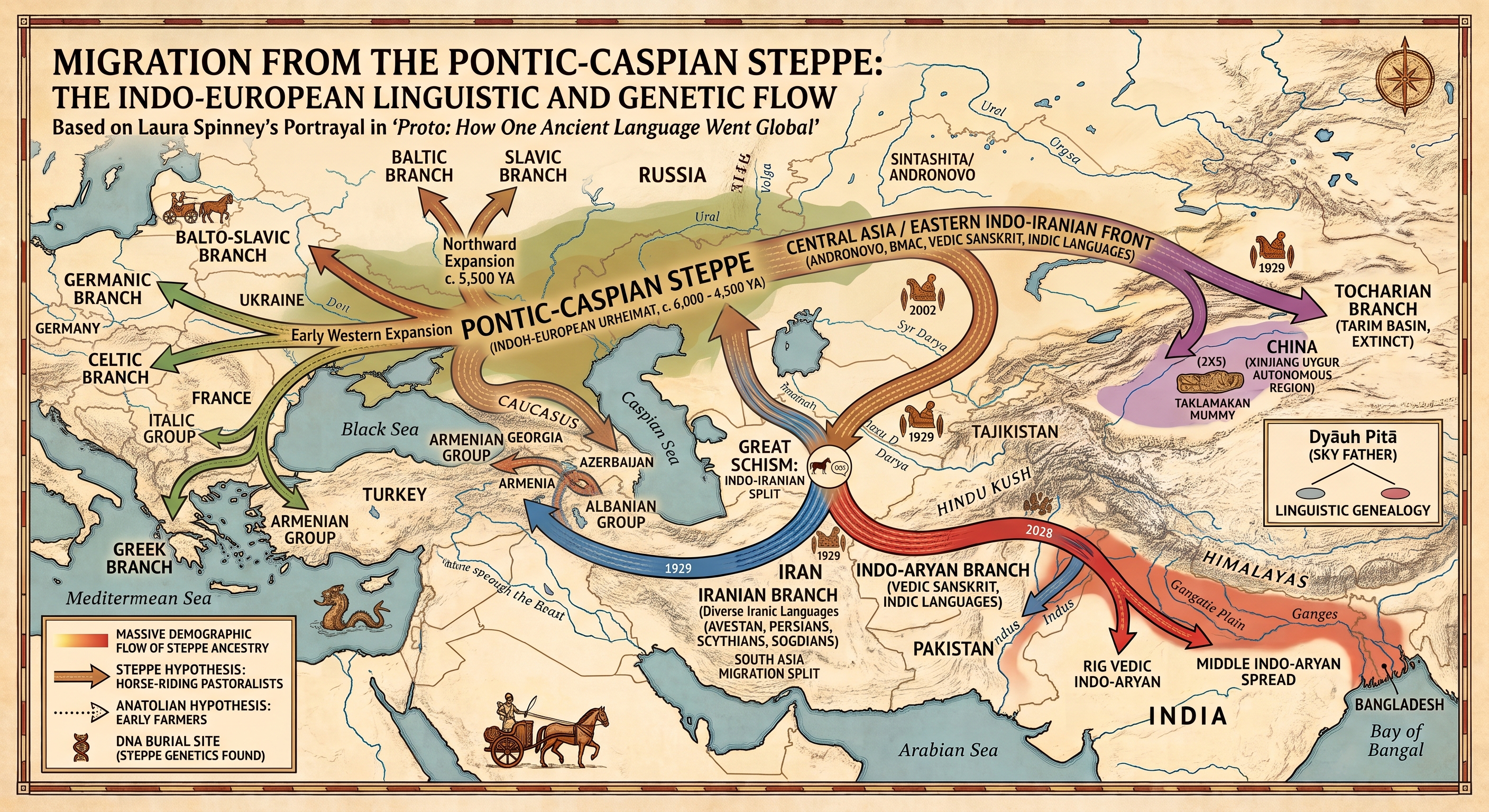
    Enter Laura Spinney’s Proto: How One Ancient Language Went Global, a sprawling detective story that stitches together historical linguistics, archaeology, and the modern revolution of archaeogenetics. Spinney maps the grand story of Proto-Indo-European (PIE), an unwritten language spoken roughly 6,000 years ago that somehow gave birth to nearly half of the world’s modern tongues.


    What Was PIE?

    Before anyone wrote poetry in Sanskrit or carved laws from Latin, a population lived on the Pontic-Caspian steppe, the vast, windy grassland that stretches across modern-day Ukraine and Russia, that spoke the mother of all Indo-European languages. They left no written records because they hadn’t figured out how to write yet. Yet, through the magic of comparative linguistics, modern scholars have reverse-engineered their vocabulary.

    By looking at shared roots across descendant languages, linguists deduced that PIE speakers lived in a specific kind of world. Because they shared words for “wheel,” “axle,” “sheep,” and “wolf,” we know they were pastoralists who rolled across the land on carts. Because they shared words for a supreme deity (Dyāuḥ Pitā, or “Sky Father”), we have a glimpse into their theological imagination. These original speakers of Proto, as is now evident from archaeological findings, were performing a version of Aswamedha Yaga (a ritual involving a horse) four thousand years before it would be described in the Rig Veda of the Vedic Hindus.

    Imagine the complexity of reconstructing a mother language using words from its offspring. It is like trying to reverse-engineer a dinosaur from a pile of turkey feathers. It’s painstaking work done by highly competent scholars. It is utterly fascinating, still speculative and not without its share of controversy.


    Steppe Nomads vs. Ancient Farmers

    How did a language originally spoken by a few hundred people spread from a pocket of the Eurasian steppe to span from Ireland to India?

    Here is where the narrative gets messy, and the academic dogfights begin. For the longest time, scholars were split down a major fault line. Was PIE the language of horseback riders who burst out of the Pontic-Caspian steppe, overrunning populations in their wake? Or did it originate in Anatolia (modern-day Turkey) with its early farmers, and spread slowly across Europe and South Asia as farming populations expanded?

    For decades, this debate was waged largely with ceramic shards and grammar tables. And then ancient DNA entered the chat. When scientists began extracting DNA from Bronze Age teeth and bones, the plot twisted pretty much in favor of the steppe horse riders. The genetic data revealed a massive demographic wave: a sudden influx of steppe DNA crashing into Europe and South Asia, neatly mirroring the spread of Indo-European language families.

    The steppe nomads didn’t just share grammar tips with each other over a campfire. They migrated in massive numbers across an enormous area.


    The Indo-Iranian Branch

    Of all the branches sprouting from the PIE tree, few are as dramatic, or culturally heavy as the Indo-Iranian branch, the focus of an entire chapter in Spinney’s book cheekily titled, “The Wandering Horse.”

    The high-octane migration of Indo-Iranians, or the ‘Arya’ as they referred to themselves, was fueled by two revolutionary technologies: spoked-wheel chariots and domesticated horses. A subset of steppe herders broke away from their northern cousins, packed their wagons, hitched their teams, and pushed south and east. They crested the towering barrier of the Caucasus and spilled out into the sweeping grasslands of Central Asia, forming a distinct cultural crucible known as the Proto-Indo-Iranians.

    For generations, these people shared a common life, huddled around campfires, speaking a unified tongue, and engineering a shared martial and spiritual worldview. But like many large families living in tight quarters, inevitably a split occurred, and they underwent a profound geographical divorce.

    The Iranians turned west and southwest, sweeping across the Iranian plateau and spilling onto the endless Eurasian steppe. Today, the Iranic languages are spoken only in the region where they are thought to have originated: Iran, Afghanistan and Tajikistan. There was a time they were spoken from the steppe north of the Black Sea, south-west to Mesopotamia and east to the Tarim Basin. Because they filled an enormous space they were highly diverse, each different from the other than are the many daughters of Sanskrit.

    By the first millennium BCE they were spoken by everyone from the horseback warriors the Greeks called Scythians, their eastern relatives the Saka, to Sogdian traders and Persian emperors. The Persians left the world one of its great poetic traditions, spanning the love poetry of Hafez and Rumi, Ferdowsi’s epic Shahnameh (The Book of Kings) and the quatrains of Omar Khayyam.

    The Indo-Aryans, in turn, pointed their chariot wheels south, carving a path through the grueling passes of the Hindu Kush, dropping down into the lush river valleys of Afghanistan, then finding their way into northwestern India and eventually migrating into the Gangetic plains of modern-day India, and eventually giving birth to the Indic languages.


    The Estranged Siblings

    How do we know this breakup between the Iranians and Indo-Aryans happened? Because their ancient texts read like the memoirs of estranged siblings arguing over family heirlooms in a probate court.

    When the Aryans settled in India and composed the Rig Veda in Vedic Sanskrit, and when the ancient Iranians crafted the Avesta in Avestan, they preserved eerily parallel religious and cultural vocabularies. They spoke different dialects under different skies, and yet they were singing out of practically the same hymnbook.

    Both traditions obsessed over the worship of fire: Agni in Sanskrit and Atar in Avestan. Both centered their religious euphoria around Soma (Sanskrit) and Haoma (Avestan), a consciousness-altering drug offered to the gods. They shared terms for priests, kings, cattle raids, and cosmic order. They had long since forgotten their ancestral address on the Pontic-Caspian steppe, but they had packed the same mythological baggage for the trip.


    Out of India or Into India?

    Naturally, any theory explaining the origins of a language family is bound to attract its share of controversies. While the overwhelming consensus of linguistics and archaeogenetics points to an exodus from the Eurasian steppe into Central Asia and India, the Indo-Aryan migration narrative has faced fierce pushback.

    In India, a vocal nationalist school has long championed the “Indigenous Aryans” theory. They argue that Sanskrit originated entirely within the Indian subcontinent and that Indo-Aryan culture was native to the Indus Valley civilization and not imported by foreign-born chariot riders. To these critics, the migration model smells suspiciously of old colonial biases that positioned foreigners as the sole custodians of civilization, an accusation that, I must admit, is not entirely without merit.

    Yet, as Spinney highlights, modern genetic data has made the “Native to India” linguistic model increasingly untenable. DNA pulled from South Asian burial sites reveals a sharp, unmistakable wave of Bronze Age steppe ancestry flooding into the gene pool at the exact historical moment the language took root.


    A Strange Sort of Poetry

    Spinney doesn’t offer neat and tidy conclusions. Her book simply tries to portray history as it happened: messy, violent, driven by climate shifts, horse breeding, and a human instinct for survival. Yet, there is a strange sort of poetry to all of it. Every time a modern Hindi speaker says mātā, or an English speaker says mother, they are unwittingly executing a linguistic hand-me-down passed from parent to child across six millennia.

    The horse-riding nomads of the steppe are long dead, their bones turned to dust beneath the grass, but their voices are still very much alive in our mouths.


    “The moving finger writes; and, having writ,
    Moves on: nor all your piety nor wit
    Shall lure it back to cancel half a line,
    Nor all your tears wash out a word of it”

    Omar Khayyam


  • The Apocalypse Gap

    The Apocalypse Gap

    I ran into a friend at a Palo Alto bar the other day. Horace is a lobbyist for the technology industry at the Pentagon, and I found him staring at his martini with the enthusiasm of a man whose Insta reel had gotten only two likes.

    “What’s wrong, Horace?” I asked.

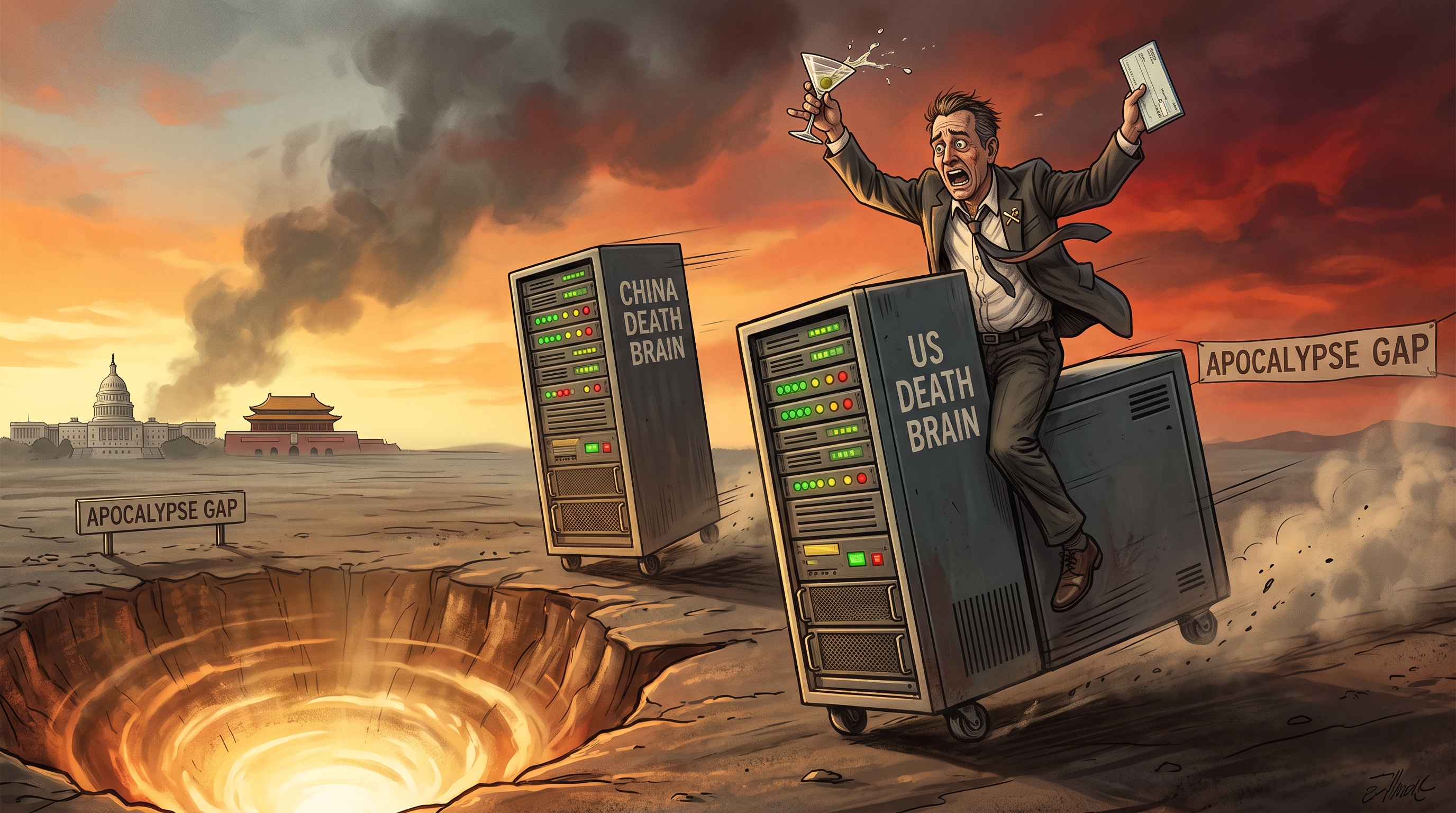
    “It’s the computer boys out here in Silicon Valley,” he sighed. “They’ve gone and built a Death Brain that is going to wipe out humanity, and now they want Washington to do something about it.”

    “That sounds quite serious,” I said. “Are you sure?”

    “Absolutely. One of their top researchers, a young fella named Jacob, walked away from his unvested stock options just to warn everybody. In this town, we understand giving up on principles, but giving up stock options? That’s like a Labrador retriever running away from a fallen hot dog on the street.”

    “What does the Death Brain do?”

    “Right now, it mostly answers emails and writes bad poetry,” Horace said. “But the companies admitted that they have had to stop the computers from going off and designing biological weapons and nuclear missiles for no apparent reason. One of their CEOs, a chap named Dario, wrote a massive essay practically begging the government to force him to stop spending trillions of dollars on building it faster and faster.”

    “That should be easy enough,” I said. “Congress loves stopping things.”

    “It’s not that simple,” Horace groaned. “You see, there’s a catch. We asked the Chinese if they would also hit the brakes on their own humanity-destroying Death Brain. And Beijing said, ‘No thanks, losers.’”

    “So, the Chinese are ignoring the warnings?”

    “Exactly. And as any good geopolitical strategist will tell you, we cannot afford an Apocalypse Gap. If someone is going to build a machine that destroys the world, it must be America, not China. We have to do it first, just to preserve our competitive edge.”

    “It makes perfect sense when you put it that way,” I nodded.

    “Trump agrees,” Horace said, signaling the waiter for another drink. “A couple of years ago, he was terrified the computers were going to trick us into a nuclear holocaust and the robots were going to murder us in our beds. Apparently, he has had a change of heart.”

    “He’s not worried about the Death Brain anymore?”

    “Not at all. In fact, he declared the whole AI Apocalypse thing a hoax. The other day, a big shot was giving a big speech about computer chips on a stage, and Trump called him on speakerphone right in the middle of it. He told the crowd that the robots aren’t taking over. He said the Cassandras of doom are just playing into China’s hands.”

    “So, what is his plan?”

    “To sprint to the finish line,” Horace said. “He thinks that whoever wins the Death Brain race, wins the whole thing. He also said the only safety guardrail the world needs is a very smart, high-IQ president.”

    “Well, it’s too bad Obama can’t run anymore,” I said. “So, what is your lobbying strategy going to be now?”

    Horace sighed. “I’m heading up to Capitol Hill to make sure we don’t slow down the AI Frontier for a single second. The Frontier has to stay in front. If humanity is going to be wiped out by a giant calculator, we have to make goddamn sure it’s an American one. I am also hearing that Congress wants to spend five hundred billion dollars to stop the computers from wiping out the human race.”

    “That seems like a prudent investment,” I said. “You can never be too careful with doomsday.”

    “What’s wrong with you? It’s a complete waste of taxpayer money,” Horace replied, dropping his fork. “Why should we spend even a dime on stopping machines from doing something we are perfectly capable of doing to ourselves anyway?”

    “I hadn’t thought of it that way,” I admitted.

    “Look at our track record,” Horace said with a fierce pride in his voice. “We have enough nuclear warheads to turn the entire planet into a charcoal briquette by next Tuesday. And we built those using slide rules and rotary phones. We did all of that with just black coffee and good old-fashioned human paranoia.”

    “So, we don’t need a Death Brain to kill ourselves?”

    “No, we don’t. It’s an insult to our own incompetence. We have spent the last hundred years polluting the oceans, melting the ice caps, and fighting trillion-dollar wars over whose grandfather owned which square foot of sand. Now, if some Silicon Valley calculator thinks it can just waltz in and destroy the globe in an afternoon, it’s got another thing coming,” Horace fumed.

    “It hardly seems fair,” I agreed. “What do you plan to tell the appropriations committee?”

    “I will tell them we have to protect American jobs,” Horace said, signing the check. “The job of driving the human race into extinction must be left to humans. By humans, I mean Americans. It should be done the good old-fashioned way. By hardworking politicians and generals, not outsourced to a glorified thermostat.”


    Have a great weekend. Pip-pip and toodles.