A review of Chris Nolan’s ‘The Odyssey’
For centuries, Homer’s ‘The Odyssey’ has been hailed as an epic, and framed as the ultimate adventure with an exotic catalog of sea monsters, seductive sirens and heroic triumph. When I heard that Christopher Nolan had decided to turn his lens toward the rock island of Ithaca, I knew I had to watch it. We watched it on Sunday.
Nolan’s ‘The Odyssey’ is grand. It’s cinematic. It’s visually splendid. It’s a sprawling IMAX spectacle that Hollywood has sorely needed to draw film viewers to the theaters. Yet, for all its visual grandeur, the film continually stumbles over its own script, leaving you with an epic that is as melodramatic and superficial as it is magnificent.
The Trojan War has ended. The walls of Troy were built by the gods. They could never be breached. And they aren’t, after ten long years. Until Odysseus devises a cunning stratagem. The Trojan Horse. Matt Damon’s Odysseus is troubled by his own guile. Nolan sets out to explore this guilt and remorse. It’s an intriguing approach. It’s unique. And I thoroughly respect it. But where the film should whisper, it screams. It deals in cliches and barely scratches the surface of the King of Ithaca’s post-war trauma.
The golden rule in telling a story is that you have to show, and not tell. If a character is nervous, you don’t have her say that she is nervous. Instead her fingers might twitch. Yet, exposition which involves direct explanation and telling can be powerful sometimes in story telling. In fact, it has been Nolan’s signature tool for a while. In his sci-fi films like Inception or Interstellar, it works so well because we NEED characters to explain the mechanics of dream levels or time dilation near a black hole so we can follow the complex plot. Even in The Dark Knight series, heavy-handed, expository dialogue works for Batman because he is a comic book hero with a larger-than-life persona.
But Odysseus is neither a space traveler nor a comic book hero. He isn’t even really a hero. He is ‘polytropos’: a man of many twists and turns. He is a deeply flawed, fiercely loyal, endlessly scheming man, hounded by the gods he neglected and routinely undone by his own pride. He gets his own men killed as often as he saves them. He is a man so driven by ego that he cannot but help shout his full legal name at a blinded Cyclops.

If any figure in mythology required a subtle handling and silent, reflective moments to breathe, it was Odysseus. But Nolan’s anxiety gets the better of him. Instead of letting that quiet grief exist in the frame, Matt Damon’s Odysseus is forced into making heavy-handed thesis statements about fate and guilt directly to the camera. When he gazes across vast, tempestuous seas, the visual composition is stunning and breathtaking. But the script underneath strips away his humanity, turning a complex anti-hero into a shipwrecked metaphor.
At one point, his men decide to jettison Odysseus because they’re convinced that Poseidon has a vendetta against their king. When confronted, Matt Damon’s Odysseus retorts, “Is this a mutiny?” That line is a perfect example of Nolan’s anxiety to drive the point home. We in the audience didn’t need Damon to ask the question. We already knew that the men were rebelling.
Then, there are the missed opportunities. A group of men sailing the high seas on their way back home never once talk about WHY they want to go back home. Perhaps a quiet moment between them where they wonder about their wives or mothers or children would have landed with devastating clarity.
Back in Ithaca, the shift toward a high-stakes political thriller suffers from the exact same flaw. Penelope navigates a predatory court of suitors with remarkable poise. Anne Hathaway’s stellar performance is sadly undercut by a script with declarative monologues. Telemachus, played by Tom Holland, struggles in the shadow of his father’s ghost, and his arc frequently devolves into predictable, angst-ridden clichés of youth. With Ludwig Göransson’s score thrumming at a perpetual 10, every single conversation is treated as an existential crisis. Without quiet moments of contrast, the drama becomes contrived, leaving the viewer exhausted rather than moved.
The Circe sequence is a tad bizarre, and perhaps overdone. It’s clever, no doubt, and quite an unexpected approach to portraying magic. But I think Nolan ended up being too clever for his own, perhaps channeling his inner Odysseus? Calypso, played by Charlize Theron, is deeply unsatisfying because it offers the best opportunity for the powerfully philosophical moment. And yet Nolan steers carefully away from anything that might be profound or moving. The scene in Hades where Odysseus pours libation to the dead, and his surprise on seeing Agamemnon there are some of Nolan’s (and Damon’s) best work in the movie.
The myth and the film carry a strikingly modern resonance, which is easy to miss amidst the grand drama. Each of us launches our own epic voyages in our work and careers, often to the detriment of our near and dear ones. We convince ourselves that the long, grueling absences are noble, necessary, and for the benefit of those who await us back at home. And make no mistake: my quibble is with neither ambition nor quests. The quests must be undertaken. Human nature demands the voyage, and we are built to test our limits and conquer our Troys.
The tragedy of the Odyssey lies not in the war fought or the distance traveled. It lies in the subtle erosion of the traveler’s soul. When we reach the end of our quests, can we really find our way back home? Or do we return as strangers, so hollowed out by the methods of survival that we bring the trauma back into our homes?
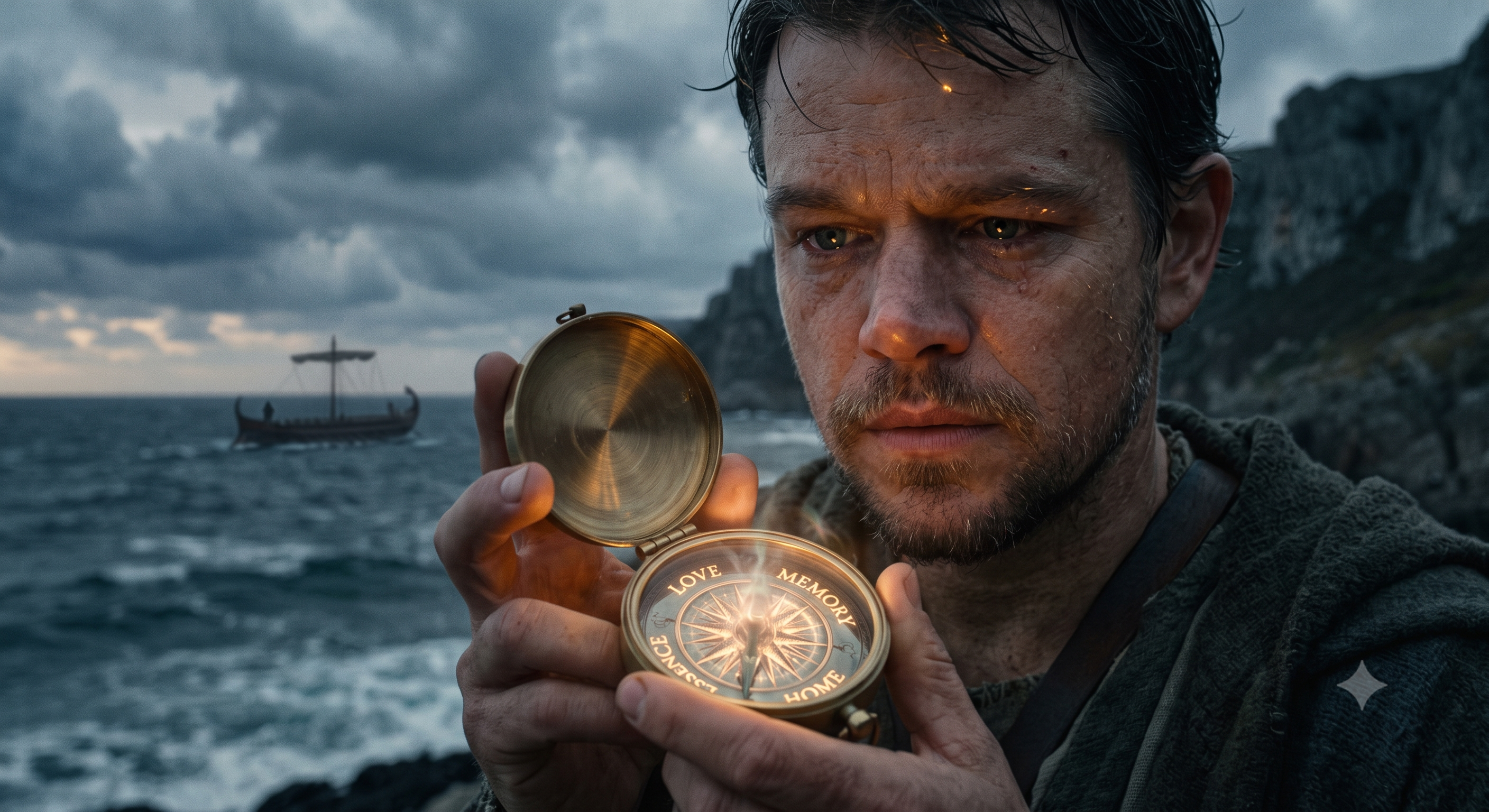
As we embark on our own personal Troys, we must firmly grip a compass in our hands, so that through the ambition and the noise, and the travel, we may retain our essence and find our way back home.
Nolan has built a breathtaking house, but the voices inside it feel hollow. The Odyssey is a fantastic technical achievement, and everyone should watch it. I only wish Nolan had had the courage to trust simplicity. He asks a vital question: how do you find your way back once you’ve lost your soul? Perhaps he shouldn’t have answered it for us.
Have a great week ahead.


Leave a Reply