Srini Chandrasekharan


Category: Newsletter

  • The Long Way Home

    The Long Way Home

    A review of Chris Nolan’s ‘The Odyssey’

    For centuries, Homer’s ‘The Odyssey’ has been hailed as an epic, and framed as the ultimate adventure with an exotic catalog of sea monsters, seductive sirens and heroic triumph. When I heard that Christopher Nolan had decided to turn his lens toward the rock island of Ithaca, I knew I had to watch it. We watched it on Sunday.

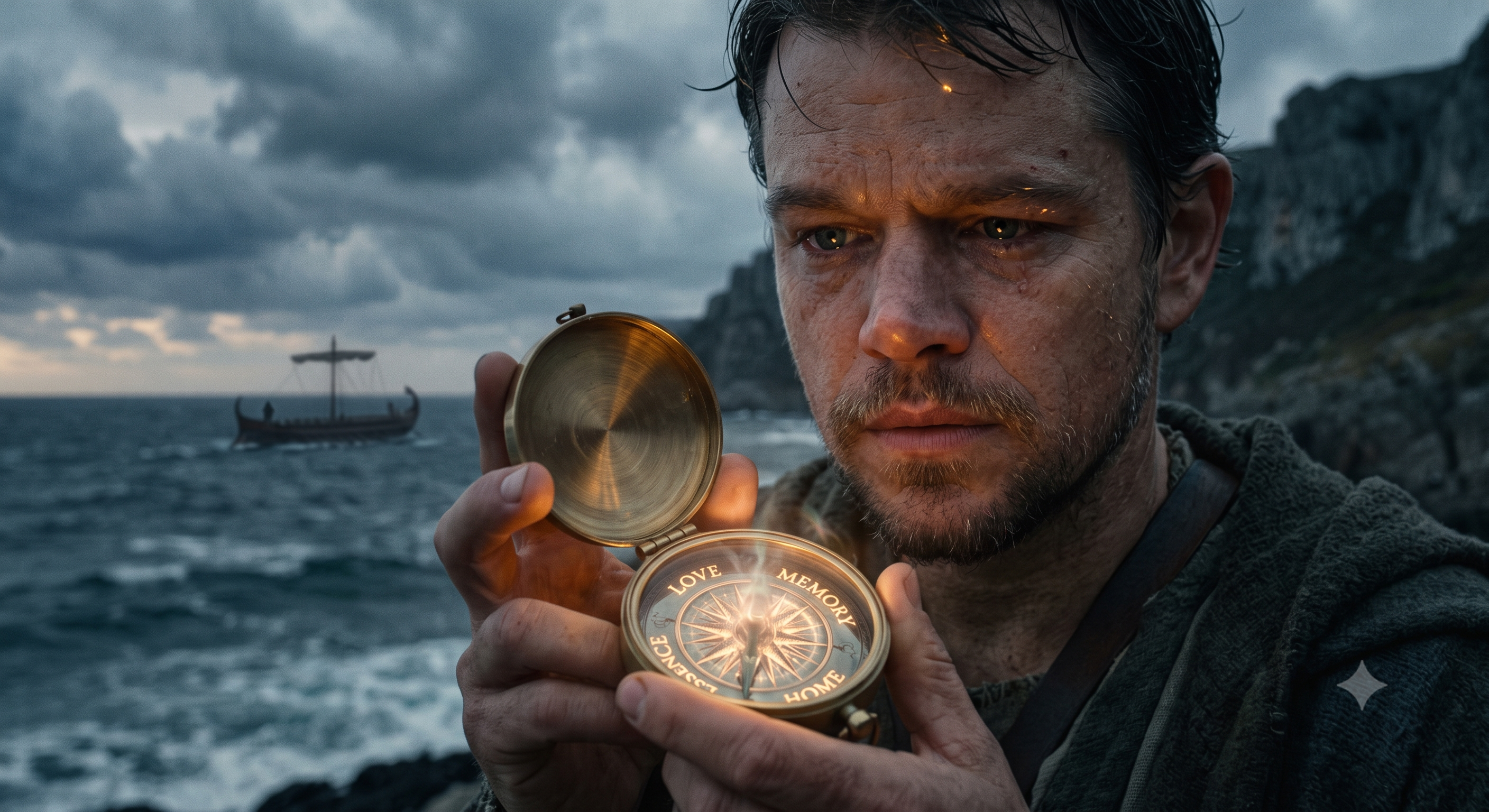
    Nolan’s ‘The Odyssey’ is grand. It’s cinematic. It’s visually splendid. It’s a sprawling IMAX spectacle that Hollywood has sorely needed to draw film viewers to the theaters. Yet, for all its visual grandeur, the film continually stumbles over its own script, leaving you with an epic that is as melodramatic and superficial as it is magnificent.

    The Trojan War has ended. The walls of Troy were built by the gods. They could never be breached. And they aren’t, after ten long years. Until Odysseus devises a cunning stratagem. The Trojan Horse. Matt Damon’s Odysseus is troubled by his own guile. Nolan sets out to explore this guilt and remorse. It’s an intriguing approach. It’s unique. And I thoroughly respect it. But where the film should whisper, it screams. It deals in cliches and barely scratches the surface of the King of Ithaca’s post-war trauma.

    The golden rule in telling a story is that you have to show, and not tell. If a character is nervous, you don’t have her say that she is nervous. Instead her fingers might twitch. Yet, exposition which involves direct explanation and telling can be powerful sometimes in story telling. In fact, it has been Nolan’s signature tool for a while. In his sci-fi films like Inception or Interstellar, it works so well because we NEED characters to explain the mechanics of dream levels or time dilation near a black hole so we can follow the complex plot. Even in The Dark Knight series, heavy-handed, expository dialogue works for Batman because he is a comic book hero with a larger-than-life persona.

    But Odysseus is neither a space traveler nor a comic book hero. He isn’t even really a hero. He is ‘polytropos’: a man of many twists and turns. He is a deeply flawed, fiercely loyal, endlessly scheming man, hounded by the gods he neglected and routinely undone by his own pride. He gets his own men killed as often as he saves them. He is a man so driven by ego that he cannot but help shout his full legal name at a blinded Cyclops.

    If any figure in mythology required a subtle handling and silent, reflective moments to breathe, it was Odysseus. But Nolan’s anxiety gets the better of him. Instead of letting that quiet grief exist in the frame, Matt Damon’s Odysseus is forced into making heavy-handed thesis statements about fate and guilt directly to the camera. When he gazes across vast, tempestuous seas, the visual composition is stunning and breathtaking. But the script underneath strips away his humanity, turning a complex anti-hero into a shipwrecked metaphor.

    At one point, his men decide to jettison Odysseus because they’re convinced that Poseidon has a vendetta against their king. When confronted, Matt Damon’s Odysseus retorts, “Is this a mutiny?” That line is a perfect example of Nolan’s anxiety to drive the point home. We in the audience didn’t need Damon to ask the question. We already knew that the men were rebelling.

    Then, there are the missed opportunities. A group of men sailing the high seas on their way back home never once talk about WHY they want to go back home. Perhaps a quiet moment between them where they wonder about their wives or mothers or children would have landed with devastating clarity.

    Back in Ithaca, the shift toward a high-stakes political thriller suffers from the exact same flaw. Penelope navigates a predatory court of suitors with remarkable poise. Anne Hathaway’s stellar performance is sadly undercut by a script with declarative monologues. Telemachus, played by Tom Holland, struggles in the shadow of his father’s ghost, and his arc frequently devolves into predictable, angst-ridden clichés of youth. With Ludwig Göransson’s score thrumming at a perpetual 10, every single conversation is treated as an existential crisis. Without quiet moments of contrast, the drama becomes contrived, leaving the viewer exhausted rather than moved.

    The Circe sequence is a tad bizarre, and perhaps overdone. It’s clever, no doubt, and quite an unexpected approach to portraying magic. But I think Nolan ended up being too clever for his own, perhaps channeling his inner Odysseus? Calypso, played by Charlize Theron, is deeply unsatisfying because it offers the best opportunity for the powerfully philosophical moment. And yet Nolan steers carefully away from anything that might be profound or moving. The scene in Hades where Odysseus pours libation to the dead, and his surprise on seeing Agamemnon there are some of Nolan’s (and Damon’s) best work in the movie.

    The myth and the film carry a strikingly modern resonance, which is easy to miss amidst the grand drama. Each of us launches our own epic voyages in our work and careers, often to the detriment of our near and dear ones. We convince ourselves that the long, grueling absences are noble, necessary, and for the benefit of those who await us back at home. And make no mistake: my quibble is with neither ambition nor quests. The quests must be undertaken. Human nature demands the voyage, and we are built to test our limits and conquer our Troys.

    The tragedy of the Odyssey lies not in the war fought or the distance traveled. It lies in the subtle erosion of the traveler’s soul. When we reach the end of our quests, can we really find our way back home? Or do we return as strangers, so hollowed out by the methods of survival that we bring the trauma back into our homes?

    As we embark on our own personal Troys, we must firmly grip a compass in our hands, so that through the ambition and the noise, and the travel, we may retain our essence and find our way back home.

    Nolan has built a breathtaking house, but the voices inside it feel hollow. The Odyssey is a fantastic technical achievement, and everyone should watch it. I only wish Nolan had had the courage to trust simplicity. He asks a vital question: how do you find your way back once you’ve lost your soul? Perhaps he shouldn’t have answered it for us.

    Have a great week ahead.

  • No time to die

    No time to die

    Less James Bond. More nicotine patches.

    “Srini, I don’t want to get a call from your daughter asking why I didn’t take care of her dad.” I’m in Dr V’s office. He is my primary care physician. We’re discussing an anti-depressant drug that can help me quit smoking. Dr V is of Indian origin (Telugu), born and raised in America. He’s about ten years younger. I can tell you the man takes his job seriously. I reply, “Look, I get it. I’ve quit before on my own. Give me another 3 months. Let me try on my own. I don’t want to take anti-depressants.” He turns from the monitor to look at me. “Okay.” We sit in the silence. He goes back to staring at his monitor. I’m looking at my shoes. It feels like I’m disrespecting him in some way. But I really don’t want to take an anxiety drug. As Dr V has been trying to convince me, anxiety and depression may be the root causes of addiction. But I’m not there yet. I break the silence.

    “Hey Dr V, let me ask you this. I know you want me to live as long as humanly possible. But really, is all of this worth it? Keeping people alive beyond their best years? What am I going to do, just going on living after my best years are behind me?”

    Dr V turns. “You’re in quite the philosophical mood, aren’t you? First of all I want to say this is not a great question to ask when I’ve just asked you to quit smoking. It feels like you’re trying to find a loophole,” he laughs. I assure him that I am not. “I’d love to hear your answer. I like the inherent conflict and tension in my question. What’s a good age to die?”

    We get up and he walks me out. I’ve clearly thrown him off his game. We stop in the corridor. “I guess it’s not really a question of how long you should plan to live. Rather, you should plan to have the zest for life as long as you’re allowed to live.” Smart. It’s a really good answer. “I’ll see you in six weeks.”

    It’s a dumb question. A man does not get to pick the age when he dies. A calendar is not a map. It is an illusion. The day comes when it comes. And the river flows not caring about the map. Can you edit the film while you’re acting in it?

    Nietzsche wrote (in ‘Thus spake Zarathushtra’) that many die too late and some die too early, and that a man should learn to die at the right time. But he did not get to choose his own time. He broke down in the street, lost his mind, and spent his last decade in a dark silence before a stroke finished him. He lived long enough to become the very warning he wrote about.

    People say time heals the hurts and makes things better. It does not. The hurt stays the same size. You can only build a bigger life so the wounds feel smaller. Time is the room where it all happens. It inevitably rots the wood and sours the wine. But, a life can be a good life if it is lived clean and sharp. The long years do not make it better. They only make it longer. Clean and sharp. What is that?

    Most of a football match is just running. Ninety minutes of toil. Men chasing a piece of leather. They sweat and they move and the clock winds down. It is ordinary work. Most of living is the same way. It is dull and you wait.

    I’m back home from Dr V’s office. Watching the Spain-France semifinals. It’s the FIFA World Cup. Then the ball begins moving. The Spanish midfielders and the forwards passing between each other. As Thierry Henry put it, it was as though the other team wasn’t on the field and didn’t matter. Every man knew his position. He knew who he was. His role. His philosophy. He has known for a long time. And then they broke through. Just like that. The moment had presented itself. A delicate tap and a pass. A kick. Suddenly it was 2-0. And I had been on hand to witness it.

    The goal did not change the map or stop the clock. It did not make the anxiety or the wounds go away. But it was a beautiful thing. Quietly great as all truly beautiful things are. I saw it and I caught my breath. I was glad I was there to see it. And just like that I knew exactly why it is worth being alive.

    The nicotine patches have been bought. The mind is being steeled. Soon, I will make the leap. Wish me luck.

    Have a wonderful weekend.

  • Normal is boring

    Normal is boring

    Give your funeral better material

    When you’re at a funeral, you’ll notice something missing when near and dear ones speak about those who’ve passed: their normal behavior. No one ever talks about how someone hoed a straight line and played with a straight bat down the pitch. We talk about their quirks. The quaint oddities. That wild thing they did once that surprised us. When you travel across the country to be with your friend at his dad’s funeral, he will tell you that you didn’t have to do it. But he will remember it forever. That you were there.

    Here’s the thing: none of us are normal. We’re all weird in our own ways. Most of us spend our lives hiding our oddities and trying to be rational. This makes sense at some level. Being rational has payoffs. Except it’s not so memorable.

    What even is normal? It has never been the same thing through time. Emperor Augustus of Rome was the most powerful man in the world in his time. He slept on a bed of hay. That was normal. He and Alexander of Macedonia and Genghis Khan and Julius Caesar never once experienced a hot shower. That was normal. I recently watched a movie about President Garfield. He was shot by a crazy man. As he lay dying, they brought in a half a million pounds of ice and blew air over it to keep the President of the United States cool. They did not have air conditioning then.

    This morning, I got up in my cool home, went to my bathroom, brushed my teeth, and had a hot shower. All normal things which were extraordinarily hard or impossible once. You, me and a million others dance on the graves of dead problems every morning in our mundane lives. Problems people once thought would never die. We solved them all.

    Here’s a crazy story.

    Dostoevsky was 28 when he faced a firing squad. Blind folded. Hands tied, he could hear the rifles being loaded. That’s when the reprieve came. At the very last second. His sentence was commuted. As it turned out, his execution was staged. Psychological torture meant to break the dissidents. It triggered a savage, lifelong epilepsy. But it never broke him. They sent him to Siberia where he worked with criminals. His epilepsy got worse.

    When he got out, he was broke. In sheer desperation, he wrote the Gambler in 26 days. He married the stenographer who typed his manuscript. Her name was Anna. Then came the big bang of creativity. Crime and Punishment. The Idiot. The Brothers Karamazov. These are some of the greatest books written in the Russian language. Possibly in any language.

    Here’s another one.

    Joseph Campbell lived in a shack for five years where he did nothing but read for nine hours a day. This was a man who had no job or income or even a plan. He called those years “the most fertile years of my life.” This was the man who wrote “the hero’s journey.” He spent five years doing nothing this world would call productive. Luckily for him, there was no WhatsApp back in the day.

    You can’t have ideas if you don’t read. You can’t articulate ideas if you don’t write. You can’t put ideas into practice if you don’t create. I don’t know why I said this. It seems to fit in this essay somewhere. But I couldn’t figure out where. So I’ve put it here instead of forgetting about it.

    It took humans over 2 million years to master fire, build homes, make spears and raise their own food. In the 16th century, something magical happened. We learned HOW to solve problems. The scientific method emerged. And the world has never been the same ever since. Every problem that has ever been solved started with a weird guess. Nothing great ever came out of people trying to be rational or reasonable. You have to be willing to look ridiculous before you’re proven right. Maybe you’ll be proven right. Maybe you won’t. But there’s something to be said for allowing yourself to consider the absurd.

    Your death is going to come on an ordinary day, amid unfinished plans and the world will go on existing without you. Go ahead and try something weird. Give them something to talk about at your funeral.

    Do write back. The weirdest comment will get a mention next week on the What Ho! Report.

    Have a good weekend.

  • A Tale of Two Mothers

    A Tale of Two Mothers

    Happy 250th, America

    This week, I have a few unconnected thoughts.

    There’s a lot being said about AI and LLMs, and how powerful they are becoming. There is a growing unease about all of this. I think it’s because a majority of people (like 90 percent of the people out there) are not tech savvy and have no way of knowing what is going on, even if it’s explained to them really well. It’s not that they’re deficient in gray matter. It’s just how tech works. Tech tends to be cult-ish, has its own jargon and lingo, and there are insiders and outsiders in this cult. In the late 1990s and early 2000s, even tech folks in software could not understand the lingo of telecom and networks, which were dramatically changing the world at that time. It’s perfectly normal to feel anxious about feeling inadequate. Trust me, you’re in good company. Some of the smartest people in the world haven’t the foggiest idea how AI works.

    For a majority of my (meagre) audience, the question is more likely: How is this going to affect my children? Most of us have crossed over to the other side and have either retired or don’t need to hold a job for financial reasons. Our concerns are more about the next generation.

    Here is what I urge you to consider: LLMs are not reasoning engines. They are probability engines. They’re not natively intelligent. They are very good at building patterns based on probabilities. If you ask an LLM, “Should I be anxious about AI?” – it will predict the answer you’re looking for and give it to you, while mimicking an expert. The key part is “giving you what you want.” Sycophancy is a bigger problem with ChatGPT, Gemini et al than even hallucination, where the AI just makes stuff up.

    But there are areas where its predictive ability is useful. This is where AI becomes the most potent. Writing code is a well structured activity. When you write code, and you write lines A, B and C, there is a fairly high likelihood D must follow, and what D should look like in a given context. Ergo, AI will become better at coding and eventually replace software programmers. I’m sure you can think of other structured activities where AI can be put to use. The thing is – even the most structured jobs have an element of judgement and unpredictability to them. So humans will stay in the picture. Their numbers will shrink but they will be needed.

    This – AI cannot reason but only predict what’s next – gives me reason to believe that society might not collapse wholesale. Will AI ever be able to reason? I seriously doubt it. Will AI disrupt the status quo? Yes, in a lot of ways. Even if AI eliminates 20-30 percent of all jobs, it will be cataclysmic. Can your kid avoid being one of those who is disrupted by AI? I don’t know if it’s possible to fool proof oneself from the coming tidal wave, other than learning to swim. A learning mindset will be super critical. Learning how to learn, the ability to self-teach, and a solid work ethic will never go out of fashion. I’d argue – encouraging your kids to teach themselves something creative and fun like a new language or an instrument – will not only enrich their lives but add a super critical life-skill to their repertoire. They will learn to teach themselves and that will pay off over a lifetime.


    Speaking of historic transformations, the biggest in human history may have been the evolution of languages. Not programming languages but human ones. Around the time humans began to farm, there were about ten million people on Earth. They spoke about ten thousand languages. No language had more than two thousand speakers. Today, eight billion people speak about seven thousand languages, which fall into 140 families. Most of us speak languages that fall into just five of them. Of these, two families are behemoths: Indo-European, whose representative is English, and Sino-Tibetan, which includes Mandarin Chinese. If you include second or subsequent language-speakers, Indo-European is by far the largest language family the world has ever known. Almost every second person on Earth speaks Indo-European. Where did these Indo-European languages start? That is the subject of the book I’ve been reading these last couple of weeks. The book is titled “Proto,” the name assigned to the mother of Indo-European languages. If this interests you, check it out.


    I have only vague memories of the weeks leading up to the day I became a US citizen in 2002. But I remember the ceremony itself vividly. It was at the Masonic Center in San Francisco. I felt moved by it. It was startling because I hadn’t expected to be moved by it. It was supposed to be purely transactional. We only got our US passports because we were moving to Singapore (and later India) at that time.

    I was born in India. Giving up my Indian citizenship felt like a betrayal, a fracture in my identity. India is the mother who raised me, who formed who I was until I turned 21. But America is the mother who adopted me, who opened her arms and showered abundant love and opportunity on a brown kid who showed up on her shores from ten thousand miles away. I am the child of two beautiful mothers. That is how it will be until the day I die. I’d dare you to find a luckier man than I am.

    I feel the weight of that destiny more than ever this week as America turns 250. This country is by no means perfect. She carries a deeply flawed, heavy history written in the scars of slavery, racism, patriarchy, and exclusion. It is a long, painful list. Even so, the light outshines the dark. America has, at her core, been a monumental force for good in this world. And the best part of this great country? Its people. I have never met people with bigger hearts, or a more restless desire to do better, than Americans.

    That is why I am proud to be an American. May God bless her. Happy 250th birthday, my dear.

    Have an amazing weekend!

  • The $300 Billion Ayatollah

    The $300 Billion Ayatollah

    A perfectly normal week in America

    It’s an incredible time to be alive. Dr. Mehmet Oz, a man who once spent 45 minutes on national TV extolling the benefits of consistent bowel movements, is now the official White House Press Secretary. Usually, a press secretary’s job is to gracefully dodge tricky questions about foreign policy or inflation. But with Dr. Oz at the microphone, it is entirely possible that a reporter’s question about the Strait of Hormuz could be answered with a recommendation for a green coffee bean extract. “Look, I don’t know much about the armed forces strategy, but I can tell you that three servings of wild yam root can do wonders to relieve your constipation.”

    Texas has decided that the best way to prepare school children to enter the modern world is to have them read the Bible. Third graders will deal with the plague of frogs before they encounter long form division. In the same week, Trump signed two executive orders directing federal agencies to protect Americans from “future quantum computers.” While Washington mandarins try to figure out post-quantum cryptography algorithms and how to avoid hacks from 2040, Texas school kids will be tested on how many cubits make up Noah’s Ark. No word yet on whether they’ll be taught that Jonah’s whale was a mammal and not a fish.

    The Supreme Court entered the chat this week with a pair of 6-3 rulings that essentially allow the administration to strip deportation protections from hundreds of thousands of immigrants and turn away asylum seekers at the southern border before they set foot on US soil. Samuel Alito, one of the justices, commented, “A guest does not arrive in a house when he knocks on the front door.” Fair point. Well played, Samuel. Just so you know, all four of Justice Samuel Alito’s grandparents immigrated to the United States from Italy. They came from Calabria on a ship and knocked on the front door. Times have changed. Now, we can hide behind the couch and pretend no one’s at home when someone rings the front door bell.

    AI is now coming for your wallet. There is a shortage of memory chips. Why is there a shortage? Because artificial intelligence companies are buying every single piece of silicon on the planet to train their large language models. Apple announced this week that this memory shortage has pushed the costs higher, and ergo, raised prices on their laptops and iPads. Basically, you have to pay more for a laptop because a server farm in Utah needs those chips to power an AI bot that can generate a picture of a golden retriever dressed as a pirate.

    First, Trump said that he had destroyed Iran’s nuclear enrichment capabilities. And then he said they had to go to war with Iran. Not sure exactly why. Hadn’t they already destroyed it? This is the guy who started his second term promising to end “Forever Wars” with “a single phone call.” Somehow, we have ended up in this logjam between the Art of the Deal and the Axis of Evil, where Trump has agreed to pay the Iranians 300 billion dollars for having assassinated their Ayatollah. At this rate, Iran is three Ayatollahs away from pocketing a trillion dollars.

    At this point, Trump is handling matters with the precision of a toddler playing with a grenade. He is getting his lunch money stolen from both sides. At one end, the Iranians are treating him like an escape room enthusiast who doesn’t know how to read the clues. They signed his “historic” peace deal on Monday and then casually lobbed a drone at a cargo ship on Thursday. Meanwhile, Netanyahu is treating Trump like a confused resident in an assisted living facility. Bibi holds his hand, points him toward the cameras for a photo-op, nods politely at his rants, and then bombs Beirut, wrecking peace talks.

    Come to think of it, learning about Noah’s Ark might not be a bad idea. If things go to hell, we might need one.

    Have a great weekend!

    PS; The FIFA World Cup is on. More on that next weekend. Enjoy the games!