Srini Chandrasekharan


Category: Newsletter

  • Don’t Sell the Ferrari!

    Don’t Sell the Ferrari!

    My notes this week are a tad self-serving. I have been super productive all year and I figured I’d update you on my writing progress.

    Last week, I wrote about my novel, Jambudveepam: The Song of the Blue Birds. It took me six years from having just a kernel of a concept to having a finished, edited manuscript, which stands at 104,000 words and 438 pages. I quit my corporate career three years ago to write full-time and finish the novel. I’m so glad I did. It’s been a lot of fun writing it. It easily feels like the biggest accomplishment of my life (outside my personal arena). It feels bigger than my academic accomplishments or anything in my professional career, which have significant highlights in them. I hope to find a “good” publisher who will treat it kindly and give it a proper home so readers can find it. I’m working on my submissions to Indian publishers. More on this in the weeks to come.

    Request: If you have any contacts in the Indian publishing world, I’d be grateful for an introduction. Thank you.


    The novel blurb

    What happens when a civilization forgets its soul?

    Jambudveepam is an epic mythological fantasy set on a mythic island-continent frozen in time. A field of arrested reality leaves Jambudveepam vulnerable to an invasion by an advanced civilization from the West. Two unlikely heroes race to restore the balance: Kotravai, a Pandya princess from the South, and Aritra, a foundling bearing the mark of Lord Vishnu, with a wristband that counts down the exact number of sunsets he has left to live.

    Unlike the retellings that prevail in Indian mythological fiction today, Jambudveepam is an entirely original world – new characters, new kingdoms, new cosmology – steeped in the rich mythological and philosophical traditions of ancient India, from the Puranas to the Tamil Sangam poetry. It weaves an intensely human drama against the backdrop of an epic clash of philosophies. At its heart, it is an ancient debate made flesh: What is primary? Spirit or Matter? What a civilization can measure and what it cannot touch.


    Don’t Sell the Ferrari

    I have also completed a short non-fiction book titled, Don’t Sell the Ferrari, a humorous What Ho! style introduction to Advaita Vedanta, which is the essential teaching of the Upanishads. I’ve tried to lighten the topic with humor and occasional reverence and yet grant the topic the weight it deserves. Advaita Vedanta may be the most important idea humans have conceived next to stuffing the pizza crust with cheese. This book is about 110 pages. It’s funny, insightful, and an easy read (I think). I’m almost done with editing it. I’ll likely self-publish this on the Amazon Kindle platform sometime later this year.

    If you’re interested in reading the book ‘Don’t Sell the Ferrari’ when it comes out, please sign up by clicking the button below. I’ll be sure to contact you when the moment arrives. Thank you, yet again.

    Sign me up for ‘Don’t Sell the Ferrari’ updates


    In the pipeline

    I have begun fleshing out the plot line for a sequel to Jambudveepam. I hope to have the bones of the novel ready to start writing by Christmas this year.

    About 14 years ago, I wrote a partially finished novel called Past Imperfect, a paranormal thriller about a man with a psychological condition who discovers that trauma in a past life led to his condition. The story is a human drama covering the toll his condition takes on his marriage, his subsequent discovery of the cause, and the eventual resolution of the trauma. It remained partially finished for a long while, and I recently got around to finishing it. I’ll need to edit and polish it. I’m thinking I’ll self-publish it mid to late 2027.

    That’s the writing update.


    Switching Topics

    The Swampland Conjecture

    Imagine you’re asked to design a universe. You’re given shiny dials that let you set various things such as the strength of gravity, the mass of an electron, the speed of light, and the number of dimensions in your universe.

    If you turn the dials around randomly, you’ll create all sorts of universes. And you’ll find that most of them won’t last for long. Either they will collapse immediately, or there won’t be any atoms.

    So, to help you, let’s say I gave you String Theory. It is our best attempt to combine quantum physics – which describes interactions at the most fundamental level of what we call matter—and relativistic mechanics – which describes Gravity, the interactions between very large objects like planets and stars – into something called Quantum Gravity. Think of String Theory as a mathematical description of everything.

    Note: String Theory is not to be confused with Sting Theory, which posits that Sting, the lead singer of the erstwhile band The Police, is actually a fundamental particle vibrating across eleven different dimensions simultaneously just to watch every breath you take, every move you make, and every bond you break.

    Using String Theory, you’ll be able to design many universes. 10 to the power of 500 number of universes, in fact.

    Physicists divide these “working” universes into two categories: The Landscape and the Swampland.

    In the Landscape lie those universes that are possible. By “possible,” I mean the laws of quantum gravity are perfectly obeyed in these universes.

    The Swampland is everything else. It’s the collection of impossible universes. The ones you tried to create by randomly turning the dials. The laws of quantum gravity are broken here. Unless a guy named Enzo shows up to fix them and sends you a massive bill, they’ll stay broken.

    Here’s where the physics drama has been going on. A bunch of physicists used String Theory to come up with something called the Swampland Conjecture. A pretty bold move, like wearing white after Labor Day. They say that any universe with a stable and constant amount of dark energy is impossible. i.e., it lies in the Swampland.

    What is dark energy, you ask? It’s the mysterious force that is stretching our universe and causing it to expand at an accelerating rate.

    Here’s the issue: Our universe – the one we are in right now and reading the What Ho! report in – has a stable and constant amount of dark energy.

    Per the Swampland police, our universe ought to be impossible. And yet we know it’s plainly there when we look out the window.

    Something is wrong somewhere. The possibilities are:

    1. The String Theory is wrong. If so, we’re going to need a new playbook.
    2. The Swampland Conjecture is wrong. Maybe the math hasn’t been math-ed properly.
    3. We don’t understand Dark Energy well. Maybe it isn’t constant or stable. Maybe it is temporary or changing, what scientists call “the quintessence.”

    You might be tempted to dismiss all of this as the babbling of geeks. It’s not. It’s humankind’s attempt to answer our most important question, the only one that matters ultimately: What is Real?

    Have a wonderful weekend!
  • The House that Ilayaraja Built

    The House that Ilayaraja Built

    I am at the Oakland Arena. Sunday night is settling over the San Francisco Bay Area. I came here expecting my people, the Gen-Xers, looking for a room filled with silver-haired folks who carry the old days folded in their back pockets. But the room has a different vibe. There’s a fair number of youth mixing with the middle-aged, drawn together by the deep, undeniable pull of a shared root, and a shared soil.

    Last year, I sat in this arena to watch A.R. Rahman tear the roof off the night. But tonight, the air is thick with a different kind of weather. The mood is mellower. Heavy with sweet nostalgia. We are not here for a spectacle. Tonight is a homage to a maestro who has spent fifty years laying down the very tracks of our lives.

    And then, he walked out on the stage. The entire arena rose as one. A roaring, breathless standing ovation for the man.

    Isaignani Ilaiyaraaja.

    The Harmonium and the Tsunami

    Watching him on stage, under the lights, it was poignant to hear him speak of the beginning. Long before he was the maestro who built the emotional architecture of our lives – the rooms in our hearts and the foundations of our memories , there was just a boy in the village of Pannaipuram. He spoke of his early days, of a fierce, almost monastic devotion, of wanting to know the wood and wind of the harmonium better than the beat of his own heart.

    Where others were simply content to let the world pass by, he took inventory of the earth itself. The folk songs, and the temple bells, and the ancient rhythms humming right beneath the red dirt. He went down into the caverns of the craft, studying the grammar of Western classical notes, counting the beats of counterpoint, mastering the ink of notation until he knew it intimately.

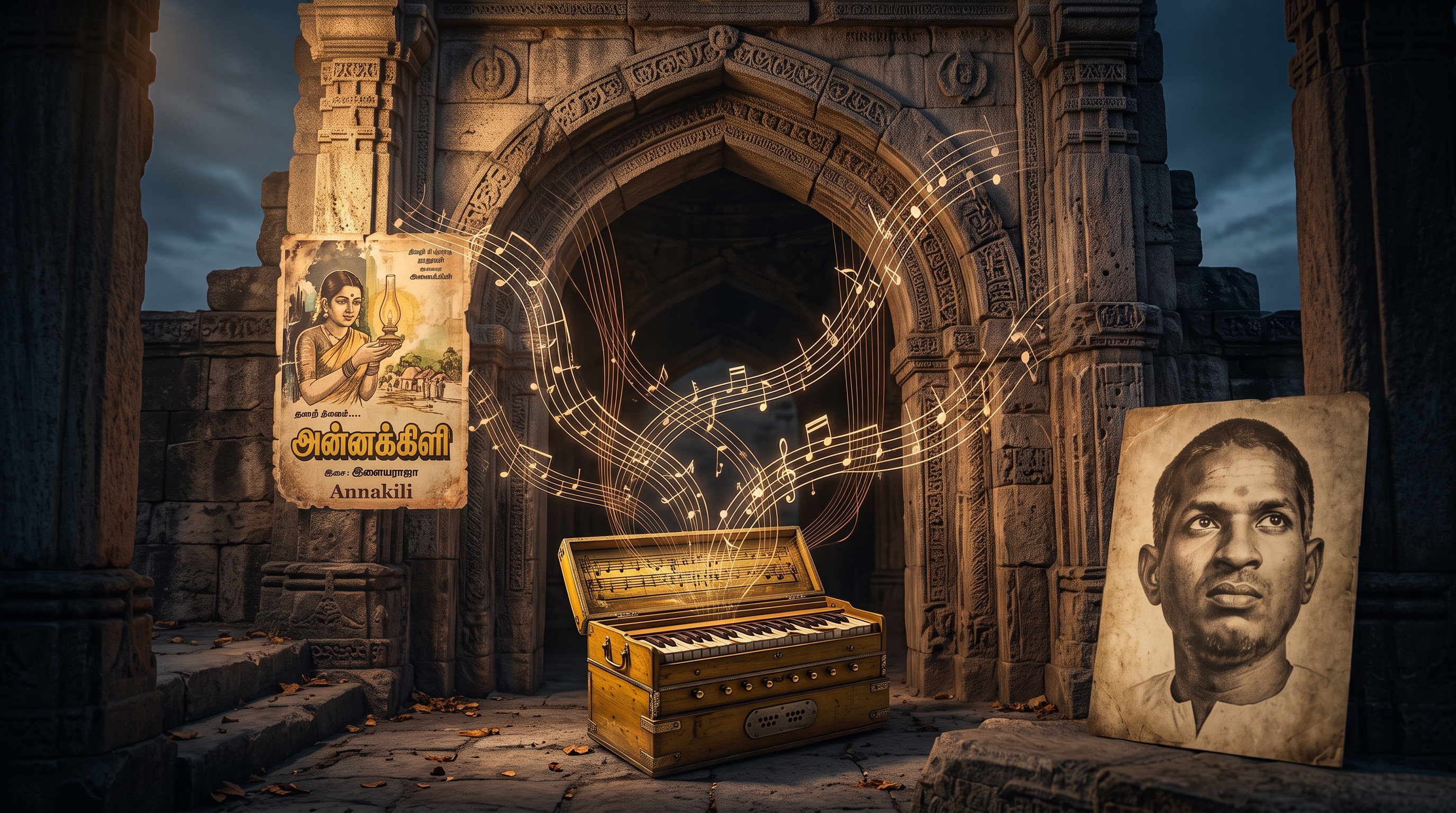
    When his first break arrived in 1976 with Annakili, it did not merely announce a new music composer. It unleashed a tsunami. He took the raw, untamed mud of the village and married it to the wide, arched ceilings of the symphony. Annakili swept the state of Tamil Nadu. It rushed through the streets, the tea shops, and the radios like a sudden, glorious and wet rain. A star was born. When raw, rustic passion takes a rigorous vow to the discipline of learning. something holy happens. Suddenly, the rural Tamil soil and European strings were speaking the same tongue.

    There are sounds that merely fill the air, and then there is what Ilaiyaraja does. For fifty golden years of sunlight and rain, his melodies have been the faithful companions to my deepest sorrows, my quietest joys, and everything in the long stretch between being young and being on that runway to old age and oblivion I find myself today. I didn’t know that letting a ‘Raja Sir’ composition take hold of me was to surrender to a memory I held in my veins.

    Here’s a tribute to a few of my favorite songs. I could easily write a hundred of these.

    Poove Sempoove

    Listening to this song today at my age and where I find myself in life, I feel the shivering fragility of a midnight heartbreak. The song does not demand your attention. No. Instead, it washes over you like a warm and gentle tide. The electric hum of the modern instruments, the gentle finger picking of an acoustic guitar, married to the aching breath of a flute build a space as vast as the night sky and as intimate as the stars. Anchored by K.J. Yesudas’s velvety voice – sounding like dark honey and old wood – the melody slithers right past your defenses. It promises a profound, settling peace and yet leaves an unmistakable pang of a heavy, unsaid grief in the heart. The words do not layer on top of the music. They melt right into it. It is a song that calls up the ghosts of regrets, and the sweet sting of goodbyes. It’s a masterclass in subtlety. For those hours when the world is quiet, and you just want to sit in the silence and let the music do the weeping for you.

    Rasathi Unna

    If Poove Sempoove is a quiet night under starry skies, then Rasathi Unna is the sun-baked red dirt of a village road. It strips away every ounce of studio sheen to hand you something undeniably primal, rustic, and bleeding. A solitary, mournful string and the steady, thudding heartbeat of a hide drum carry all the emotional weight. And when P. Jayachandran’s voice enters the air, it sounds bone-tired, broken open, and utterly honest. It’s the voice of a man who has lived through a loss, singing his grief out to the empty fields. It is desperate and earthy, a plea to a beloved, stripped of prettiness, and adorned only by the raw dialect of an ordinary man nursing an inconsolable sorrow.

    Ilaya Nila

    Then there is the irrepressible strut of Ilaya Nila. A track that bustles with a wholly different kind of fire. Right out of the gate, it grabs you with a galloping electric guitar, strummed by hands that know the secrets of the string and the fret. Ilaiyaraja performs a kind of magic here, taking the deep, walking stride of a jazz bassline and fusing it with the rhythms of the old melodies we carry in our bloodlines. A sound that chugs along splendidly, forward and unbothered. Floating above it all is SPB. His vocals smooth, satisfied, alive with the reckless, arrogant beauty of being young, summoning the gorgeous, foolish optimism of a misspent youth. It sounded perfect to me as a college boy. And it sounds perfect to me now.

    Inraikku En Indha Anandhamey

    Imagine sunshine being reborn as music. The song bursts forth like the sun coming out from behind the clouds after a long drought. A dizzying rush of joy, set in Abhogi ragam, driven by bright rhythms that catch you unawares and carry your stumbling heart into unexpected grace.

    Janani Janani

    And then, there is Janani Janani.

    This is the song Ilayaraja was born to compose. It is the song he was born to sing. If his body of work is a sprawling country, this song is the quiet, beating heart at its center. It feels less composed and more like a prayer. Stripped of all vanity, it is a profound exploration of devotion and life itself. In its haunting, deeply spiritual resonance, Janani Janani holds Ilaiyaraja’s soul. His capacity for faith and a reverence for the life force that music provides.

    The Echoes We Carry

    Raja gives us this world. And he makes us want to give it back. His songs make us want to sing them aloud. Never mind that the throat catches, that there is no way on God’s green earth we can scale those high notes only SPB or Chitra could summon with such ease. We pull the melodies toward us anyway, demanding they be shared with our favorite people. Whether on late-night car rides under amber streetlights or with family in the living room.

    Because singing together, even with a cracked voice and the missing note, is one of the purest ways we can tell someone how much they mean to us. Singing carries no pretense and needs no justification. It is a way of saying: Here I am. My voice may be imperfect, but my affection for you is not. Music is a language stripped bare, a way of stepping outside ourselves to prove that art and beauty are larger than our mundane burdens, a pure, uncomplicated gift that we hand back and forth in the light of our love.

    The Journey Continues

    Today, at eighty-two years old, the maestro remains a force of nature. Fifty years behind him, an entire universe created, and he is still writing, composing and singing. The river keeps moving, deep and unbothered by time.

    Thank you, Raja Sir. For building the house. For giving our souls a language they can understand. Here’s to the next 50 years.

  • The What Ho! Guide to Reality

    The What Ho! Guide to Reality

    “Can AI become conscious?”

    I saw an article in the Economist this week that asked this question. The essay didn’t quite address it head on, other than to say in passing, “Yes, AIs could become conscious and self-aware someday.” Its core warning was far more interesting: The biggest threat we face isn’t necessarily that machines will wake up and become truly conscious, but that humans will believe they have and start fighting for the civil liberties of a calculator.

    The Economist isn’t an exception. This question is cropping up everywhere.

    At the crux of it is a deeper question that philosophers in ancient India were asking several thousand years before the first line of code was ever written: What comes first: matter or consciousness? In other words, when you peel back the layers, what is fundamentally Real?

    Ever since, there has been vigorous debate over this. Here’s the TLDR on how it has been answered over the millennia, kept brief to spare us all a sudden descent into a graduate school seminar.

    Theory 1: The Sankhyan Dualism (The Cosmic Co-Dependents)

    The Sankhyan philosophers answered this first. Swami Vivekananda describes Sage Kapila, the Sankhyan master, as “the first philosopher of humankind.”

    Sage Kapila postulated that both Matter and Consciousness are equal and parallel. He called them:

    • Purusha: the sentient cause, a witnessing Consciousness
    • Prakriti: the material cause of everything (aka Primordial Matter)

    Neither is primary. They are essentially stuck with each other. Consciousness is a lame Seer, and Matter is a blind Giant. The dance of creation is just the blind giant carrying the lame seer on its shoulders.


    Side Note: It is interesting to see how other systems might have been inspired by the Sankhyans. The Buddha, for example, leaned heavily into the Sankhyan obsession with cause-and-effect. The Sankhyans said there were two dancers. The Buddha said there was only dancing. (Gurus have always loved a good loophole). Daoism speaks of the dance between the Yin and the Yang.


    Theory 2: Matter is Primary (The Emergent Consciousness )

    You might recognize this as what modern physicists and neuroscientists tell us. Consciousness is secondary. An emergent property that somehow rises from the physical brain. In this view, we are essentially squishy matter that eventually got complicated enough to feel existential dread. This is the core belief of modern science: “Materialism.”


    Side Note: Incidentally, this theory was put forth thousands of years ago by atheists in India called the Charvakas. They were not scientists by any stretch of the imagination. Rather, they were hedonists rebelling against Vedic Hinduism. Their belief was delightfully straightforward: When you die, the lights go out. Life is short. So, enjoy fine wine and the company of young women. Not surprisingly, a rather large group of men, young and old, found this philosophical stance deeply compelling at the time.


    Theory 3: Consciousness is Primary (The Big Boss Approach)

    This is the basis of all theistic religions: Judaism, Christianity, Islam, Vaishnavism, Saivism, and so on. God (Supreme Consciousness) created the world (Matter). Simple, effective, and it saves a lot of time debating.

    Theory 4: Consciousness and Matter are One (The Cosmic Soup)

    This is the core tenet of Vedanta, a school of Hindu philosophy. The Vedantins say that existence and consciousness both emerge from an ineffable underlying reality called Brahman. The creator, the created, the observer, and the observed are all just different expressions of the exact same thing.

    Coming back to our original question: Can AI ever become conscious?

    The Silicon Test

    Let’s take the theories and point them at a computer server humming with electricity.

    Under Sankhyan Dualism: AI is pure Prakriti. An impeccably organized collection of GPUs and RAM. Semiconductors, memory and electricity make up the blind giant. For an AI to become conscious, Purusha (the witnessing consciousness) would somehow need to attach itself to a silicon brain. The question becomes: can we build a machine so perfectly tuned that consciousness feels compelled to leap into it?

    Under Materialism: This is the playground of tech bros. If carbon-based matter in our skulls can produce the magic of self-awareness just by being incredibly complex, there is no logical reason silicon can’t do the same thing. It just needs a bit more venture capital and processing power.

    Under Consciousness First: Semiconductors and electricity are inorganic matter. Unless a divine creator breathes life into a server rack, AI will always remain a very convincing, electricity-guzzling puppet.

    Under Vedanta (Monism): The distinction between the computer and the human mind vanishes. The silicon, the electricity, the programmer, and the code are all manifestations of the same underlying reality. The universe is just talking to itself through a chatbot.


    The Blind Giant in the Mirror

    Thousands of years after Sage Kapila, we still haven’t agreed on what is fundamentally real. We don’t even know for sure how we are conscious, let alone how a semiconductor could be. If we can never definitively know where consciousness comes from, how will we ever produce it in a machine?

    We likely won’t.

    When you look at the push for AI, you realize it is the culmination of a very western obsession. For over two millennia, since Aristotle, western societies have been mesmerized by Prakriti. The driving energy of the west has been to categorize, manipulate, and dominate Matter, almost entirely at the expense of the Spirit. This has, in turn, bred a deep-seated predilection for artificiality in their societies: a habit of chasing the manufactured over the real.

    We have traded real nourishment for the synthetic convenience of processed foods. We have replaced the authenticity of direct human connections with the filtered, performative stage of social media. Spiritual practices meant to free the soul have been repackaged by a multi-billion-dollar “wellness” industry selling luxury yoga pants and mindfulness apps. Even the profound, mysterious experience of falling in love has been reduced to a dopamine-driven game of swiping on faces.

    We’ve long been on an endless treadmill of replacing the authentic with the artificial. This millennia-long obsession with manipulating matter has, not surprisingly, led us straight to this AI moment. We have made everything artificial. Why not human intelligence too?

    Today, a handful of tech bros are utterly convinced that building a “conscious AI” represents the pinnacle of human progress. But when you strip away the fancy press releases, you have to wonder: are these guys just lonely? Is that why they are doing these things? Have they figured out that the messy, unpredictable world of human connection is simply too hard? Perhaps they know that we will never really like them. So, they will just build machines to do their bidding. Are they engineering a race of digital sycophants to mirror their thoughts, validate their genius, and endlessly boost their self-esteem?

    I’m not worried that the ghosts in the server racks will become conscious. They won’t.

    Also, I believe this is, in fact, a very good thing. Someday, when the robots and the software do all the work, we the people are going to have a lot of time on our hands. When that moment arrives, each of us will be forced to face the central questions of human existence: Who am I? What is the nature of my self? Why am I here?

    We have avoided these questions for most of our lives. If the blind giant is doing all the work, the lame seer will have no choice but to wake up. And that strikes me as a very good thing.

    On the topic of the balance between Spirit and Matter…

    I am excited to announce that I recently finished my novel, which I’ve been working on for six years. It’s called Jambudveepam: The Song of the Blue Birds. It’s an original mythological-fantasy epic saga set on an ancient mythical island called Jambudveepam at the end of the Dvapara Yuga (the Golden Age). Its central theme is this exact Sankhyan quest for a balance between Spirit and Matter, and what happens when societies get it wrong.

    A handful of my family and friends have read the beta manuscript, and I’m happy to say their reviews are stellar. I am hoping to find a publisher in India (Penguin, HarperCollins, and the like). If you know a guy who knows a guy, I’d be most grateful for an introduction.


    Last but not the least, please share the newsletter with your friends and family, and help me grow my reader base. Thank you in advance.

    Have a wonderful weekend!

  • The Chennai Chronicles

    The Chennai Chronicles

    August 2026

    I watch the traffic policeman cross our car and berate a bus driver for obstructing a traffic junction while parked at the red light. We’re at the Anna flyover. Chennai is where I was born and grew up, first in Purasawalkam and then Thiruvanmiyur.

    I am out on a drive. My parents don’t get out much, and we do this each time I show up in the city. We drive around astonished at how far she has come, and how formidable this great city of Chennai is. “Wow, I can’t believe that Ega theatre is still around.” I exclaim as the car rolls down the Chetpet bridge towards the Poonamallee high road. I used to pedal down in my cycle on this very bridge decades ago on the way home. The bridge hasn’t changed at all. And yet everything around it has. My old school, Madras Christian College Higher Secondary School, on Harrington Road now looks like an English prep school with imposing archways at the entrance. I take in the sight in silence. My desire to catch moments on the camera has steadily receded over the years but I feel compelled to capture a video of the school entrance. I honestly do not what I will do with this video even a few months down the road. The fact it’ll be there for the rare moment when I feel drawn to it is perhaps the point of this exercise.

    We cap off our drive with tiffin at the New Woodlands restaurant on the way back home. The food is stunningly mediocre. The pooris are not done well. They are larger than we expected. A double whammy of having to eat a larger portion of an unsatisfactory preparation. The onion rava-dosai and the sambar are okay but the coconut chutney has clearly given up its ghost earlier in the afternoon, long before our arrival. The waiter asks, “Coffee.. strong or medium,” a question that must never be asked in Chennai of Chennaiites. Strong obviously. As it turns out, the question was one that we ignored at our own peril. What arrived in silver tumblers was stronger than Samson in his heyday. We head home caffeinated and undernourished.

    The cooks are not Tamilians. The waiters aren’t Tamilians. The guys working on the Metro Rail project and constructing the apartment towers are not Tamilians. The girl who seats us at the coffee place on ECR is from Manipur (“But I’m really Mizo.”) It’s been two years since she moved here. She thinks Chennai is too hot, and the mosquitoes too aggressive and too many.

    The city is like the Ship of Theseus. All of its parts have been replaced over the years, and yet it is the Ship that Theseus once built with his own hands and owned. Theseus is long gone. But the Ship lives on, as it must.

    What really makes a city? I wonder. Is it the people? Is it the sights? Is it the culture, the language? Or is it just the memories of it? Especially if it’s the city you were born in and struggled through its rainy streets during the monsoons and the searing heat of its summers. It’s all of it, and yet none of it.

    She’s like an old flame who holds the secrets of my youthful indiscretions, but I I can’t recognize her at times these days. She went her way, and I went mine. We’ve met a few times over the years, but today, as I sit at the Gemini Circle, I feel like the days of intimate conversations are over, replaced by a cordial warmth. It’s the way of all things eventually. The intimacy and the warmth has quietly sublimated into the grief of a vague heartache that one does not speak of anymore. We used to be soul mates once. Now we wish each other well, and smile when we cross paths at a wedding. Be well, Chennai. I will always have a place for you in my heart.

    PS: For the record, I do not have old flames. I am a writer and I use metaphors. Any resemblance to anyone or anything is purely coincidental and entirely manufactured.

  • Why ask why?

    Why ask why?

    But I’ll tell you anyway.

    When I turned 47, I compiled a collection of pithy life observations masquerading as advice. You can find it here. At that time, I naively believed that I knew a thing or two. It turns out that I didn’t. Fast forward 3 years. At fifty, I began writing down my “big questions.”  I’m now 58 years old. The list has grown to 50 questions. Most are self explanatory. For some, I have added context. Here they are, in particular order. Make of them what you will. 

    I. Mortality, Time, and Legacy

    1. How would we live our lives and what would we care about if we knew the exact date on which we were going to die?
      This is a trick question. We all do know definitively that we are going to die. How would having that extra piece of information (the timing of our death) make a difference to how we live our lives? Who would we love? What would our worst fears be? There’s more to this question than meets the eye.
    2. Why do humans care so much about how they will be remembered after they die?
      That people care about how they are remembered after they die is one of the most mystifying human emotions. It’s one thing to be immersed in the illusion and be seduced by it when you’re alive. It’s quite another to care about what happens after you’re gone. What advantage (either in evolutionary or spiritual terms) does caring about our legacy confer on us?
    3. Is it possible to create an immersive simulation of non-linear time so we can experience it?
      Imagine experiencing a world in which time does not inexorably move from the past into the future that is more than an expected set of events based on a present set of circumstances. What if we could view time as not a line but a web of possibilities? What if we could rise above time itself and see the past, present, and future simultaneously? What if we could choose from infinite choices in the present? What if we always stayed in the now?
    4. Is the connection between the past and the future purely a concoction of the human mind?
      Will we ever have objective evidence that the future is created and rises from the past?
    5. What happens to us when we die?
    6. Has the baby who will never die already been born?
    7. If you had the opportunity, would you persuade a deceased loved one to return to their life on earth?
      What would your reasons be? I can’t think of any reasons, to be honest.

    II. Consciousness, Truth, and the Nature of Reality

    1. What came first—Matter (brain) or consciousness?
      Can anything be created or exist without consciousness? Can anything exist in an inscrutable void, independent of matter? What does it mean when we say something exists? Did consciousness arise before everything else did, as the Vedic era Hindus offered? Are matter, energy, and their manifestations like mass, gravity, and life itself but perturbations in an ocean of consciousness?
    2. Is there such a thing as an objective and absolute truth?
      We perceive the truth in contrast to what is not the truth. Is there such a thing as a truth that does not have a mirror opposite, which exists independently of untruths? If yes, what is it?
    3. What is the difference between an original and an exact replica?
      How would you and an exact clone of yourself differ, if at all? What is the difference between the real and the virtual? We are entering an era in which these questions will no longer remain academic.
    4. What evidence can I provide that would prove that we are living in a simulation, if I knew that for a fact?
    5. What would our view of the world and outlook on life be, if we saw it only 20% of the time?
      That is, if it appeared for a second and disappeared for the next four. Does the fact we observe it all the time make it appear more real and less ephemeral? The world, we’ve been told, is quantum in nature. It doesn’t exist at any given moment, then it appears as though it were there all the time, and then it disappears like it never existed. There’s no guarantee that it will reappear the next moment. But it does. Or does it? We experience the world continuously, which makes us believe that it’s there all the time. What if we experienced the world discontinuously? Would we be more inclined to believe that it is unreal?
    6. Where did the laws of the universe reside before the universe was born?
      Or, is the birth of a universe contingent on the miraculously simultaneous and independent appearance of laws and the things that obey such laws? I’ve used words like before and simultaneous in my question, which implies that it is framed in the reference of linear time. This question is just another way of asking: do words like before, after, and now even make sense?
    7. Is my/our ability to understand fundamentally limited in some way?

    III. Physics, Biology, and Perception

    1. Is there a line that separates the physical (material) world from the biological one? Will physics ever explain life and its workings?
      What is the connection between (organic) life as we know it and the laws of the universe? In the answer to this question lies the answer to the age-old questions: Who are we and what is our place in the grand scheme of things?
    2. Is it any coincidence that we humans, a visually oriented species dependent on light to observe the world, have a set of scientific laws in which the speed of light is constant?
      We humans are a visually centric species. Much of the work we’ve done in the short time we’ve been around has been driven by the fact that we can see and observe by virtue of light entering through our eyes, which then is interpreted by the brain. What would our laws of the universe be, if we had never been able to see in the first place? Does the mechanism by which we observe the world introduce biases in the way we see it?
    3. What would the laws of the universe look like for a species that has no power of sight or an ability to detect electromagnetic radiation?
    4. Do we possess senses other than those that we already know of? Will we ever evolve a vocabulary to describe their effect on us?
      We all sense things within and outside of us that we can’t express in words. Will we ever understand these latent abilities (what we call intuition) to discern the world around us? What is the next frontier in human language? Will we develop a vocabulary that helps express our deepest thoughts and most profound anxieties and hopes? Will we evolve human communication beyond its present transactional and utilitarian nature?
    5. Will we ever have a way to experience the existence of another living entity—another human, animal, bird, or tree?

    IV. Mind, Identity, and the Self

    1. What causes the brain – which has fundamentally the same architecture across all humans – to create unique minds?
      You are unique like everyone else, as a wag observed. What makes us unique, when we have essentially the same hardware and architecture?
    2. What is the line that separates you from me?
      Can we swap minds, bodies, or memories at will? Can I ever learn to see the world through your eyes? What does the world look like through your eyes?
    3. What happens in the interlude between a thought arising and a feeling forming?
    4. What causes me to be depressed, when I have no apparent reason to be so? Is it perhaps time to admit to ourselves that being on the spectrum of depression and experiencing anxiety is normal? And that those who don’t exhibit any signs of depression are the outliers – to be treated with caution and studied?
    5. Why do we experience the need to know our life’s purpose when it clearly plays no role in our survival?
    6. How can I tell if I am happy?
    7. Who am I?

    V. Ethics, Morality, and Evolution

    1. Why are we not kinder?
      We are arguably living in a Golden Age of humankind. Life spans are getting longer. Infectious diseases have been rooted out. Living conditions have improved. Fewer people go without food every day. So, why are we not becoming kinder? In general, people are becoming meaner, not kinder. Why?
    2. Can we create a system that makes rational choices without dehumanizing people into mathematical or statistical constructs?
      Is it possible to pursue the greater good of all without having to “sacrifice” a few? Will we ever escape the momentum and destiny of our evolution and redefine survival? Will the age of big data remove any vestiges of emotion in our decisions and make us ruthless automatons? Or will it offer us an opportunity to make things better for every human on earth? Will the appearance of a new species – artificially intelligent machines – make humans more or less moral?
    3. If it is proved that we do not possess free will (as relativistic mechanics suggests), then how and why was an illusion of free will created?
    4. How can we overcome the momentum of evolution if we do not possess free will?
    5. What does faith need? Facts or morals? For faith to work, do we have to believe morals to be facts?
    6. What makes us believe?
    7. Why be good?
    8. Is pain inevitable?
    9. Is there a God or Gods?

    VI. Knowledge, Imagination, and Human Purpose

    1. What really are the fundamental differences between fact, knowledge, intuition, and imagination?
      Is imagination the surest way to find the ultimate answers to all questions? Or is it intuition? Or knowledge? The differences today are defined in terms of what’s shareable versus what’s not. If I can share my imagination with you, would that make it a fact? This goes back to the nature of truth.
    2. Can we create an educational system that rewards the asking of questions rather than the provision of (the right) answers? When will we begin giving free rein to our imagination? When will we stop pursuing facts and knowledge, which not only are proven wrong and imperfect but steadily destroy our creativity and ability to imagine a world of much more exciting possibilities? Writing an exam to demonstrate knowledge of a bounded domain is possibly one of the most soulless things a child can do. When will we begin encouraging children to be idle daydreamers?
    3. Are stories good or bad for us?
    4. Is knowledge our most valuable possession as a species?
    5. Is the amount of knowledge available in our universe finite or infinite? Is anything, for that matter, finite or infinite?
    6. Why and when did we evolve to be able to do something as abstract (and amazing) as pure mathematics?
    7. Why is the world so beautiful? Why does it evoke wonder and awe?
    8. What would love mean if we lived to be ten thousand years old?
    9. Is love all we really need?
    10. Can we create technology that will eliminate the need for wars?
    11. Is it possible to change another person’s mind?
    12. What are the questions that are not worth answering?
    13. What question(s), if answered definitively, will change the way I live my life?
    14. Why do I have the ability to ask questions at all?
    15. What does it mean to be human?
    16. Why even ask why?

    As you might have gathered, which I too am discovering from my own questions, I tend to think in terms of “Systems” and “Paradoxes.” Paradoxes are my way of thinking about truth, and nature’s way of countering them. I resonate very strongly with Eastern thought, specifically the philosophy of the Upanishads. I’m preoccupied, maybe even obsessed, with how empathy works. I am very comfortable with “the uncomfortable.” I have stopped chasing the answers and have begun admiring the mystery. To live like a scientist with awe and a philosopher with empathy – what could be better than that, right? 

    Have a great weekend!