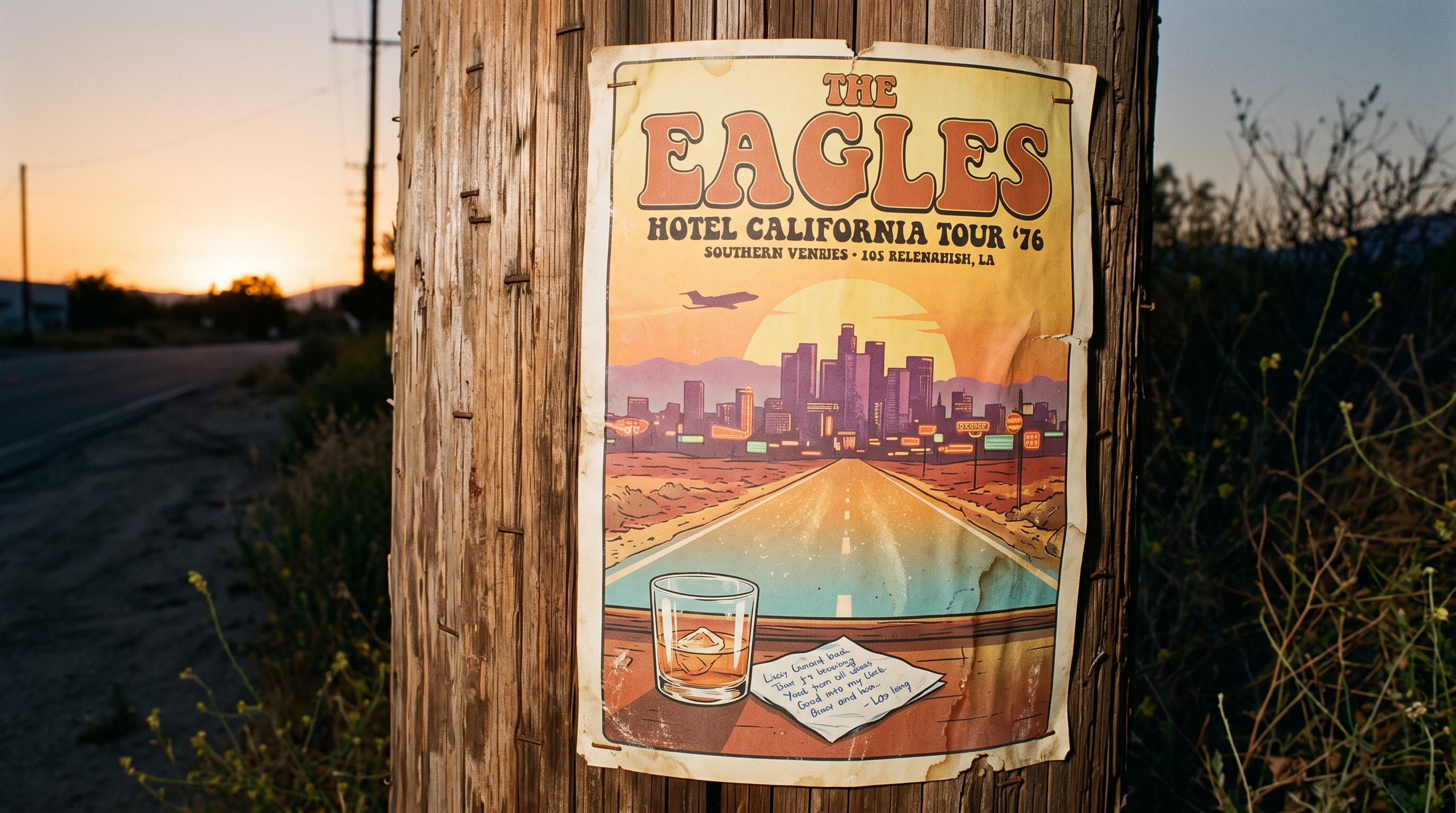
Time, as we have come to understand it, is a shimmering mirage. Paul Rudd is older than Ted Cruz and Taylor Swift is only a year younger than Adele. Rock and roll’s relationship with Father Time is equally fascinating. Men and women barely into their twenties, dewy young people with nary a mark on them write soulful ballads with shattering maturity. And they grow old, and it all comes true.
By the time the Eagles released Hotel California, they were knee-deep in experience.
Ankle-deep, at any rate. The Southern California sound, which they had helped invent, ruled the airwaves. Mildly rocking, beautifully harmonizing, with silvery sleek songs, the Eagles found the elixir. Their previous album, Greatest Hits (1971-1975), was a behemoth. It would go on to be the biggest-selling U.S. album of the 20th century.
Hotel California is in some ways asshole music, an introspection from the window of a Learjet. But it’s also self-aware, and wonderfully crafted, and superbly exquisite in places. It is of its time. It drips with foreknowledge. The weird breeze, the mirrors on the ceiling? We are all just prisoners here, of our own device. Luxury gone rotten, an approaching storm. From his gold-plated heyday Don Henley somehow glimpsed it. He smelled it. And you know what, it’s still there. This Hotel California, this shimmering American palace of God-knows-what, is still our future.
The 1970s was the decade when country music went Californian, and the Eagles became the platinum-selling soundtrack to the west coast generation. When they released One of these Nights in the summer of 1975, that album brought them to a whole other level of success. It was their first LP to reach Number One on the Billboard album chart, and the singles were all over the radio. “Lyin’ Eyes” was written by Don Henley and Glenn Frey one night when they saw a young couple talking and imagined they were in the middle of a secret affair. “We saw a lot of beautiful women around Hollywood who were married to wealthy, successful men, and wondered if they were unhappy,” Frey said. “One night we were drinking in a bar when I spotted this stunning young woman. Two steps behind her was a much older, fat, rich guy. We all started laughing and one of the other guys commented, ‘Look at her, she can’t even hide those lyin’ eyes!’ Immediately, we all began grabbing for cocktail napkins to write down lyrics to go with that great observation.”
The song’s deeply resonant opening, “City girls just seem to find out early,” took six different tries. The tune, produced by Bill Szymczyk, also features Henley on backing vocals, Bernie Leadon on lead guitar, mandolin and backing vocals, Don Felder on acoustic guitar, Randy Meisner on bass guitar and Jim Ed Norman on piano.
“As the saying goes, Henley could sing the phone book and make it sound interesting, but Glenn was a great storyteller,” Leadon told Rolling Stone. “Just listen to the way he sings ‘Lyin’ Eyes’.”
That attention to detail paid off. Not only was “Lyin’ Eyes” a hit on mainstream and country radio, but it also earned the group a Grammy Award for Best Pop Vocal Performance by a Duo, Group or Chorus and a nomination for Record of the Year. The song is the only one on the One of These Nights album that sees Frey singing solo. The Eagles would never again reach such heights with country listeners, mainly because they were moving toward a more rock-focused approach. Their next crossover Top 40 hit didn’t arrive until 2007, with “How Long.”
‘It won’t be bound in leather books and handed down from generation to generation,’ said Don Felder, talking about the band’s music in 1975. He was so wrong.
Leave a Reply