In the mid-19th century, the German philosopher Friedrich Nietzsche famously and rather angrily proclaimed that “God is dead,” Note: He was rarely invited to dinner parties. Championing nihilism, he envisioned the Übermensch, a superhuman who rejects godly idealism to forge his own values and turn his life into a personal masterpiece.
Nietzsche would have hated Silicon Valley, He asked for Ubermensch, and all we came up with is an app for a slightly cheaper taxi.
Astonishing as his audacity was, Nietzsche was neither the first nor the last to take up cudgels against the Almighty. Two millennia earlier, Anaxagoras brought philosophy to Athens alongside a healthy dose of pessimism about the divine. Voltaire echoed the sentiment, and post-WWII luminaries like Bertrand Russell confidently predicted religion’s demise at the hands of science and technology.
There is little evidence that such rumors ever reached the East—or if they did, that anyone took them seriously. Hinduism had already weathered its own godless crisis a millennium prior, spurred by naturalist philosophies like Buddhism and Jainism, and the Purva Mimamsa tradition, which boldly declared a Creator unnecessary. That school eventually faded, unable to compete with the mass appeal of visual allegories, practical metaphors, and a vibrant pantheon of deities. The Eastern tradition has always been to co-opt, not compete. It embraces rather than rejects, which is likely why a Reuters survey once found a quarter of Indians perfectly open to believing in the gods of other religions, too.
Is God alive in the 21st century?
As questions go, it’s an odd one. Was belief in God merely a solace for times of famine? A way for the Greeks to make sense of lightning? Have we lost the Almighty in the woods of our self-centered modern rituals?
Despite centuries of intellectual doomsday predictions, the secularization thesis has flopped. Nietzsche is dead; God is not. So much for the Übermensch.
A global Reuters poll found that well over half the population across 23 countries remains utterly convinced of a divine entity and an afterlife. A Pew report revealed a staggering 92 percent of Americans believe in God or a higher power. Even in Europe, the historical cradle of Western enlightenment, over half the population still keeps the faith. The “Big Five” religions continue to thrive, proving that rumors of God’s demise have been grossly exaggerated.
What happened?
Proponents of secularization assumed scientific advancement would cure us of superstition. Their fallacy? Humans aren’t genuinely looking to quantum physics or selfish genes for comfort. Human angst is intensely existential: Who created me? Why am I here? What happens when I die? These are questions science has yet to answer convincingly—or palatably.
“Nothing in Particular”
The Pew data on the US—the world’s great melting pot—tells a fascinating tale. For instance, there are as many Buddhists as Muslims in America. But what’s truly mind-blowing is the largest single demographic after Christians: the “unaffiliated.” This group includes atheists and agnostics, but it is dominated by a category delightfully denominated as “nothing in particular.”
Think about that. A massive chunk of the world’s most affluent nation aren’t atheists or agnostics. They are just… nothing in particular. It is the fastest-growing religious demographic in the country.
Science hasn’t wiped out religion, but organized faiths are clearly losing their grip, struggling to soothe modern existential angst. The story is far from over, and the market is wide open.
The Entrepreneurial Pivot
Questions ignored by mainstream religion are increasingly answered by articulate gurus, new-age preachers, dynamic swamis, and even militant atheists. We are witnessing the implosion of the Big Five religions into a buffet of disaggregated modules, ripe to be packaged, rebranded, and sold by enterprising founders to niche markets. It’s a thousand Arab Springs in the world of organized faith.
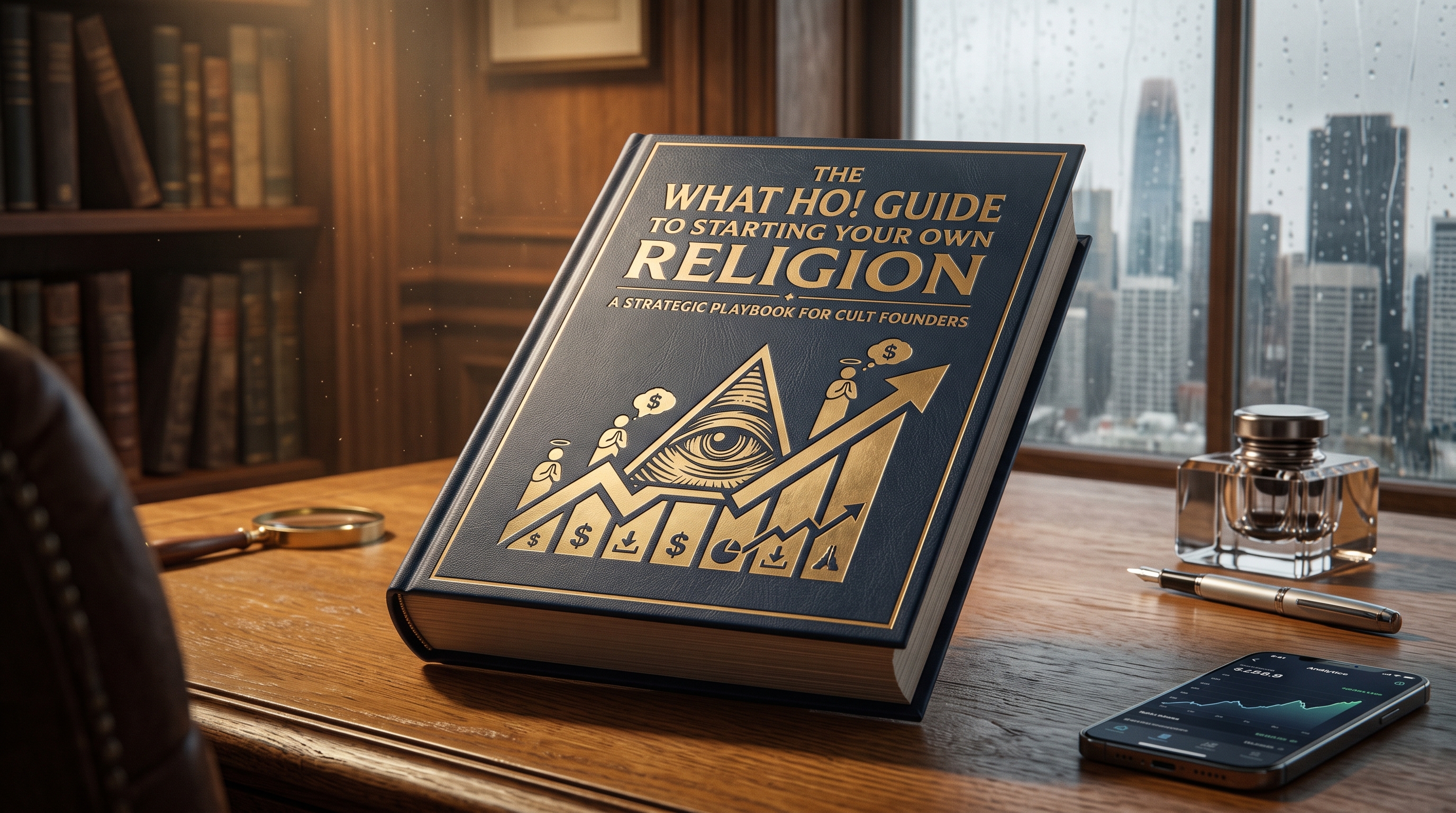
For aspiring founders looking to capitalize on this burgeoning market, here is an exclusive excerpt from A Dummy’s Guide to Starting a New Religion—a magnum opus slated to hit Amazon anytime now.
The Entrepreneur’s Guide to Starting Your Own Religion
A clear mission is key
You will one day have billions of followers. You need them to be purposeful missionaries who actually understand your goals. Your mission statement must be easily translatable into 105 languages.
Bad example: “Our mission is to assertively network economically sound methods of spiritual empowerment so that we may continually negotiate performance-based outcomes in the hereafter.”
Good example: “A stupa in every zip code.”
Find your niche and differentiate
There was a time when only a fool and his money were parted. Now it happens to everybody. Study the market, identify those most willing to open their checkbooks, and craft a bespoke narrative. A little bit of Zen, a dash of karma, heavy doses of instant gratification, and absolutely no mention of Hell. That formula kills with aging Hollywood stars and high-achieving corporate honchos.
The Product Definition Checklist
Now, define your product to meet your user base’s darkest longings:
Deity count: Decide if you will have one God, many Gods, or no God. There are massive addressable markets for all three.
The Post-Game: State your position on the Hereafter. Does it go dark? Is it a velvety coolness? Or are you reincarnated as a North African dictator? Hint: Heaven is in. Hell is out. Also, know your demographics: surveys show a solid 20 percent of afterlife-believing Britons just want to chat with Princess Diana.
The Origin Story: Be intriguingly vague on creation. Statements like, “In the beginning, there was this huge, monstrously big bang,” resonate wonderfully with the STEM crowd.
Open Source vs. Proprietary: Will you “open source” your religion, allowing the devout to tinker with the code of conduct and add as they go? Or will you keep it a walled garden? Open sourcing aids long-term survival (Hinduism is a great open-source religion), but it has bugs. Random users will add features no one needs, like goat sacrifices. Furthermore, the ecosystem becomes so complex that all the glory (and monetization) goes to the third-party swamis providing tech support. Keeping it locked down ensures you, and you alone, control the user experience. Steve Jobs championed locked-down systems and was universally eulogized. Dennis Ritchie helped write Unix, the precursor to open source, and died the same week to near-total silence. How big a dent do you want to make in the universe?
The Call to Action
Sales is about closing the deal. Older religions flounder not from a lack of sales reps, but from a lack of a compelling case for timely subscription. The pitch, “Get on the train NOW, or rot in Hell forever when the world ends in 60 days,” yielded incredible conversion rates for Paul of Damascus around 33 AD. Conversely, “Here’s a list of eight things you can do to be happy” didn’t exactly set the world on fire for Siddhartha in 600 BC. Create urgency.
Embrace the PR spin
There is no such thing as bad publicity. Wild Doomsday predictions or carefully timed bouts of ashram-hopping might attract controversial attention, but they drive traffic and garner Twitter followers. A lesser-known retention strategy involves PTO: a real religion should require no fewer than six fixed national holidays and three floating ones. Err on the side of abundance. It plays exceptionally well in populous, festival-loving markets like India and Brazil.
Nomenclature matters
A name is often the only difference between a unicorn and an abysmal failure. Don’t rely on dead English dramatists (“What’s in a name?”). Sergey and Larry named their company after a fictitiously humongous number, and it became a verb. Naming after fruits is risky unless you’re an unbreakable, off-kilter genius in a black turtleneck. Names starting with ‘Z’ usually sound cool.
Finally, figure out what to call the people who unsubscribe. Calling them infidels or heretics and condemning them to eternal damnation is generally considered poor user offboarding.
Carpe Diem
Here’s to the crazy ones, the misfits, the rebels, the round pegs in the square holes. Here’s to you, the brave new cult leaders of a brave new millennium. Seize the day. Seize the checkbook. God bless.
Disclaimer: Extensive research went into this piece. No priests, rabbis, gurus, lamas, or militant atheists were harmed in its making.


Leave a Reply