Srini Chandrasekharan


Category: Humor

Humor from What Ho!

  • The What Ho! Guide to Driving in India

    The What Ho! Guide to Driving in India

    The Uninformed Reader might scoff at, and even under-estimate the significance of the dark art of driving in India. To her, I must point out that data collected from observation of Indian drivers has been the only reason that scientists have been nail down the exact moment in time we homo sapiens branched off from our ancestors.

    Say what? What ho, let me explain. Scientists estimate that humans branched off from chimpanzees exactly 7 million years, 240 days ago, at 11am in the morning. They were able to nail this date and time down precisely by comparing remnants of chimpanzee DNA found in Expert Indian Drivers and DNA found in normal Homo Sapiens (aka lesser mortals). By analyzing the differences, they were able to compute the time it must have taken for 100% pure chimpanzees to mutate into half-ape, half-human entities – otherwise known as – yep, you got it – Expert Indian Drivers.

    So, scoff not and read on.

    The What Ho! Guide to Driving in India

    1. Never assume anything. Assumption is the mother of all screw ups

    Let’s start with an example. When driving on the Outer Ring Road in Bangalore, you might consider yourself blameless for assuming it to be a major roadway of sorts, on which traffic flows unencumbered. In an unguarded moment, you might carelessly flirt with the notion of putting metal to the pedal and speeding things up. Wrong assumption.

    India is a country of 1.2 billion people, living on 3.3 million square kilometres of land. Unfortunately, the Reddy brothers own 75% of land in India, and so the area available to the rest of us boils down to a fraction of what it could be. There’s not much room to move around in this country of ours. What this means is that the average Indian has to conduct his business in public. Consequently, terms like Outer Ring Road, National Highway 4 (NH4), etc. are loosely meant to describe anything along the lines of children’s parks, playgrounds, parking lots, race courses, cattle sheds, places of worship, venues for cricket matches, etc. However, I will concede that on rare occasions, traffic might be allowed to pass through. But, that’s besides the point. The point is – don’t let names lull you into making wrong assumptions.

    A sure sign that you don’t have active remnants of chimpanzee DNA in your system is that reading this will have the effect of either frightening or depressing you or both. Despair not.  There is good news. There still exist those places you can drive freely with abandon. It’s just that, thanks to our lack of attention to detail, we’ve named these places wrongly. For example, pavements, airport runways, residential streets, gated communities and parking lots are places where you can roll the windows down and experience the joys of driving on an open road. When you find yourself in one of these locations, feel free to let your hair down and have a wild time.

    While we’re on the subject of assumptions, I feel compelled to go on a tangent to belabor a related point. I’ve often noticed a mistake committed by neophytes in the process of mastering the road shastra. Which is to assume that there will be sign boards at the sides of the roads, and these aforesaid sign boards will convey meaningful information. Out here in this lovely land of ours, sign boards are akin to newspapers. They are the best places to get information on movies that have been just released or the scoop on the local elections. Experts are beginning to come around to the point of view that traffic sign boards may be the sole and ultimate reason why we have a citizenry that has unusually high levels of general knowledge.

    2. There is something called “Too much information”

    The fact that you are driving on the road does not imply that you should pay attention to or know everything that is going on around you. Listen carefully when I say that there is something called “too much information”. There is no better place in the world that this phrase applies than on Indian roads. What this means is simply, you must not, I repeat, must not absorb any information about the goings on around you. Road nirvana, which is the zero information state, has thus far been achieved only by auto rickshaw drivers and cyclists who, scientists claim, closely resemble random particles in Brownian motion. The Nirvana state has been described as a blissful state of simply being, in which illusions of material activities around the self are obliterated into complete nothingness. Trust me when I say that your iPod may be your best friend on the roads. Put on your favorite music, crank up the volume and get set to experience moments of bliss. In fact, this article was conceived, typed up and posted while driving from work to home.

    In other words, do what you feel compelled to, unmindful of anything else that may be going on around you. Stay focused on gaps in spaces ahead of you (or behind you, as the case maybe). Make it the sole purpose of your existence to penetrate those gaps faster than a photon shot through the Large Hadron Collider.

    3.  Be aware of the power of stationary objects

    Technically, this falls both into both categories of “wrong assumption” and “too much information”. But, this insight carries such enormous significance that I felt compelled to call it out separately so what ho! readers do not miss its import.

    Surprising as it may sound, some of us are human. And, it is a natural human tendency to associate driving with motion. For the humans amongst us, driving raises strong visual images of steering an object that is moving. Under certain circumstances, it turns out that nothing could be farther from the truth. Yes, there will be those situations when the best form of driving is to suspend all motion.

    First, let’s understand the critical benefits of static energy on Indian roads. The case for stillness and complete lack of motion starts with the important point that a stationary object will never be blamed. This is especially true of static objects found in middle of roads. Examples of stationary objects are bull dozers, city buses, large groups of people buying and selling stuff, Manmohan Singh, traffic policemen, abandoned vehicles, small and large sized animals, and occasionally birds in addition to the usual fare of impediments such as stupas, edifices and national monuments which are there on roads for the sole reason that it hasn’t yet occurred to anyone to move them. In fact, a team of archaelogists have carbon-dated a 5-foot tall granite stump smack in the middle of NH4 as belonging to Chandragupta Maurya’s period. So, for thousands of years, we Indians have learned to navigate around animate and inanimate objects that we encounter in our paths.

    Now for how to convert this blinding insight into an actionable plan. When in trouble or doubt, immediately convert yourself into a stationary object. If you’ve been slipping and making the mistake of absorbing information from your surroundings while driving, you will find yourself nervous and paralyzed with shock from time to time. When this happens – Come to a complete halt, switch the engine off and have a cigarette. Use the break wisely by catching up with the latest bhangra beat or calling your near and dear ones. Because you’ve converted yourself into a stationary object, no harm can and will befall you. The traffic will begin to magically adjust, weave and make its way around you, while you enjoy beatific solitude and the stiff drink that you so richly deserve.

    So, there you go. The 3 commandments from our “Beginner’s Bible for Driving in India”.

    Astute readers will point out that there are those other rookie mistakes like assuming that – to drive, you’ll need a driver’s license, should be possessed of eyesight, should be older than five years of age, etc. etc. – all of which, I’m sure you’ll agree with me by now, fall into the categories of wrong assumptions and too much information.

    In parting, I must point out that you must realize that not every one amongst us is destined to master the road shastra and get behind the wheel. For those who have suffered Fate’s cruel sleight of hand in not having adequate chimp DNA in the system, all I can say is – Treat your driver like a Greek god and make burnt offerings every day at the altar.

    If you liked this, you’ll enjoy reading Horn OK Please – on the delightful practice of honking on Indian roads.

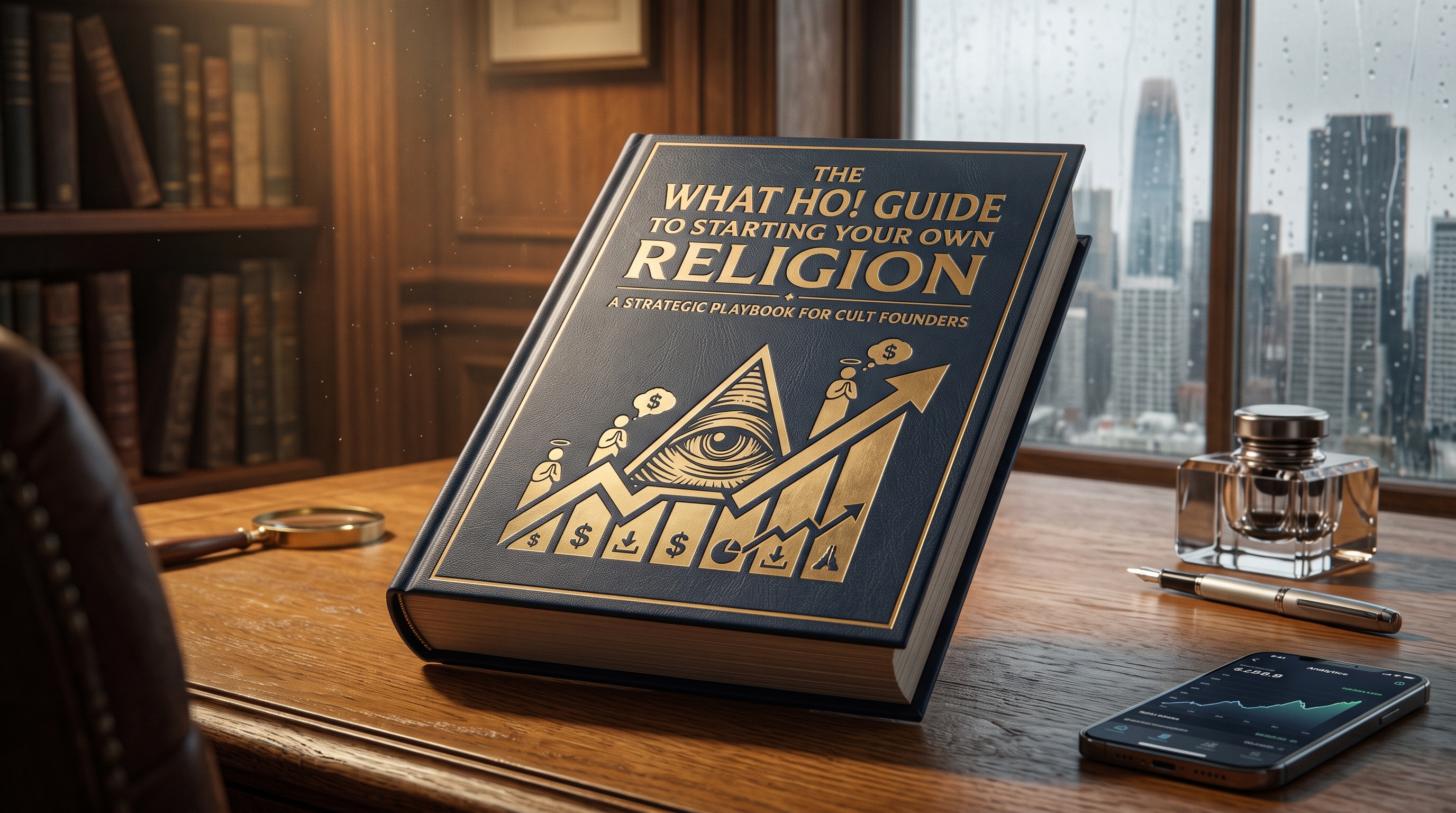
  • The What Ho! Guide to Starting Your Own Religion

    The What Ho! Guide to Starting Your Own Religion

    In mid 19th century, Nietzsche, a German philosopher, angrily and famously proclaimed that “God is dead”.  Nietzsche spoke favourably of nihilism, a school of thought which essentially negates godliness with its attributes of ‘idealism’ and ‘perfection’, and went on to describe a Ubermensch (“beyond Man”) – a superhuman who posits his own values and creates a life which is his own personal work of art.

    As astonishing as Nietzsche’s audacity was at that time, he was neither the first nor the last to take up the cudgels against the Supreme One. Voltaire, and if we rewind by 2,000 years, Anaxogoras, who brought philosophy to the great city of Athens, had expressed pessimism about the existence of Deus Populi. Darwin, Marx and Engel and luminaries of the post World War 2 era like Bertrand Russell, took up the secularization baton and confidently predicted the decline of religion with advancement in science and technology.

    There is no evidence to suggest that such rumours reached the East, or even if they did, were taken seriously. Hinduism had already gone through a wave of cleansing more than a thousand years before Nietzsche, forced in part by the emergence of godless, naturalist philosophies such as Buddhism and Jainism, and the Purva Mimamsa tradition of Vedanta, which declared the non-existence of God ‘with a form’ and that there really was no need to postulate the existence of a Creator for this universe, a thought interestingly in consonance with the Parabrahman of the Rig Veda. After a brief burst of dominance, the Purva Mimamsa school faded into oblivion, unable to hold the appeal of masses more attuned to visual allegories, practical metaphors and pantheons of deities. In fact,India led a Reuters survey on the “many gods question” with 24 percent of Indians declaring their “openness to believing in many gods and in gods of not just their religion”. The Hindu tradition has been to co-opt, not compete. It has been to embrace rather than reject, perhaps one of the reasons it survived the onslaught of competition over time.

    Is God alive in the 21st century?

    As far as questions go, this is an odd one. Is God is still alive in the twenty-first century? Was belief in God only a solace in times of famine? Was He perhaps a last resort for Greeks to make sense of thunder and lightning? Do we need God? Is He still our “ultimate concern” Or have we, the human species, lost God somewhere in the woods of our self-centred rituals?

    Despite the plethora of predictions for centuries by prominent scientists and intellectuals regarding the disappearance of belief in God, today it is evident that the secularization thesis has failed.  Nietzche is gone. God is not. So much for Ubermensch and nihilism, although one could argue that some sort of passive nihilism was always an undercurrent of and continues to stay alive in Vedanta, Buddhism and Jainism, the great movements that arose in the East long before Nietzche learned his alphabets.

    According to a Reuters poll, belief in a god, or a supreme being, and some sort of afterlife is strong around the globe. Well over fifty percent of people across 23 countries who took part in the survey said they were convinced there is an afterlife and a divine entity, while 18 percent said they don’t believe in a god and 17 percent weren’t sure.

    According to a Pew report on religion in the United States, a staggering ninety two percent of people stated that they believed in God or a higher power. Even in Europe, that bastion of secularism and cradle of “western enlightenment”, over fifty percent of the population continues to express belief in the existence of God.

    It is evident that rumours of God’s demise have been grossly exaggerated. The “big 5” religions (Christianity, Islam, Hinduism, Buddhism and Judaism) continue to thrive, and the faithful continue to be strong in numbers.

    What happened?

    Proponents of secularization incorrectly imagined that scientific advancement would render superstition unnecessary and would wean us away from god(s). The fallacy in this hypothesis is that humans are not, and have never really been interested in more information on quantum physics, selfish genes and angry birds. Instead, human angst is existential and wells from questions such as “who created me?”, “why am I here?” and “what happens to me when I die?” – enquiries that science and technology have not really come anywhere close to addressing convincingly or palatably.

    “Nothing in Particular”

    The numbers from the Pew report of the survey done in the US, the world’s melting pot and the most influential country in the world, tell a fascinating tale. For example, there are as many Buddhists as Muslims in the United States. Bet you wouldn’t have guessed that. What’s really mind blowing is that the largest single group in the US, next to Christians, is “unaffiliated”, at 16% of those surveyed in the Pew report.  This group includes atheists (1.6%), agnostics (2.4%) and a category interestingly denominated “nothing in particular” which clocked an astounding 12 percent of those surveyed.

    Now, think about that for a minute. Slightly more than 1 out of every 10 persons in the world’s most affluent country describes themselves as belonging to “nothing in particular”. They are not atheist. Not agnostic. Instead, they are “nothing in particular”. This category is the fastest growing religious demographic in the United States.

    Secular movements and scientific progress have not wiped out religion. But, it appears that the organized religions of the world are simultaneously losing their grip, thanks in measure to their own brand of inadequacy in dealing with human existential angst. In short, this tale is far from being over, and might have a few twists left in it.

    My take

    Questions in people’s lives, addressed by neither science nor mainstream religion, are being increasingly answered by articulate and sophisticated gurus like Deepak Chopra and Eckhart Tolle, new age preachers like Oprah Winfrey and Tony Robbins, dynamic swamijis like Baba Ramdev and Sri Sri Ravishankar and militant atheists like Richard Dawkins and Christopher Hitchens. We predict that this millennium will witness the implosion of the big five religions into a buffet of disaggregated modules, which in turn, will be packaged, re-branded and sold by enterprising entrepreneurs to niche markets. A blossoming of a thousand Arab springs in the world of organized religion, if you will.

    To aspiring entrepreneurs looking to capitalize on this burgeoning market, we are excited to provide a guide to ideating, commercializing and scaling of your endeavour. Here are excerpts from our “A Dummy’s Guide to Starting a New Religion”, a Laughing Gas magnum opus, which is yet unwritten but slated to be available on Amazon before the end of next year.

    The What Ho! Guide to Starting Your Own Religion

    Clear mission is key

    As obvious as it seems, a clear mission is key. Remember that some day, you will have millions or even billions of followers. You should aim to convert as many of them as possible to willing and purposeful missionaries, who actually understand your mission. A mission statement should be easily translatable into 105 languages.

     Bad example:

    “Our mission is to assertively network economically sound methods of spiritual empowerment so that we may continually negotiate performance based outcomes in the hereafter”

     Good example:

    “A stupa in every zip code”

    Segment the market, find a profitable niche, and position yourself to differentiate

     There was a time when only the fool and his money were parted. It now happens to everybody. Study the market and identify those most willing to part with their checks and craft a well designed story for them.

    A little bit of Zen, a dash of karma, heavy doses of instant gratification and no talk of Hell, for example, is likely to do well in the lucrative sub-segments of aging Hollywood stars, high achieving entrepreneurs and corporate honchos.

    The product definition checklist

     Now that you have identified your customer, define your product to meet his deepest and darkest longings. Here’s a little checklist to help you get going.

     First, decide if you will have a God, many Gods or no God.  There are large sized markets for each.

    Second, state your position on the Hereafter – is there one? Or does it go dark when the lights go out? Is there a velvety cool blackness or are you reborn as a North African dictator?

    Hints: Happiness and heaven are in. Hell is out.  Those looking into Western European markets should keep in mind that the survey says that 20 percent of Britons, who believe in life after death, can’t wait to speak to Lady Diana in the post bucket kicking phase.

    Third, be intriguingly vague on creation. Statements like “In the beginning, there was this huge, monstrously big bang” have been known to resonate very well among the scientific types.

    Fourth, decide if you want to keep things open or closed?

    Should you “open source” your religion or should you keep it “closed and proprietary”. In other words, are the devout allowed to tinker with the ‘source code of conduct’, make stuff up and add as they go along? Or perhaps, you’d prefer to keep things “inside the house” and lock everything down?

    Open sourcing is about freedom and flexibility, things which aids growth and survival over the long haul. Hinduism is a great example of an open source religion. There are two major problems with this, though. First – random folks will add random features that no one needs. Was there ever really a crying need for goat sacrifices? Second – open source systems tend to become so complex and confusing over time that a robust support infrastructure is required. Which means the glory (and the money) goes to the myriad swamijis, gurus and babas, who support the system by interpreting it, rather than the original founders. Keeping things locked down, on the other hand, has its benefits as you, and you alone, control the user experience.

    This decision will have a bearing on your personal fortune and fame. Two men recently died within a week of each other. One championed proprietary, locked down systems and ruled that universe with an iron hand. This man, Steve Jobs, was eulogized by half the world and their pets within hours of his passing. The other invented the C programming language and helped write Unix, the precursor of open source systems. Bet you didn’t even know that his name was Dennis Ritchie. So, open source or proprietary? A lot depends on how big a dent you want to make on the universe.

    Urgent and compelling call to action

    Selling is a transaction that involves the completion of an exchange of (typically) money for something of value (a product or a service). The operative word in that sentence being “completion”. Sales is about ‘closing the deal’.

    Nothing closes the deal better than an urgent and compelling “call to action”. Older religions have floundered not because of lack of salesmen, as is believed, but in reality because of lack of a compelling case for timely subscription.

    For example, the pitch –  “Get on the train NOW, or rot in Hell forever when the world ends 60 days from now” yielded amazing results for a certain Paul of Damascus around 33AD. In contrast, the pitch “Here’s a list of eight things you can do to be happy” didn’t exactly set things on fire for a certain Sakhyamuni in 600BC.

    No such thing as bad publicity

    As the adage goes, there is no such thing as bad publicity. Jigging things up to be jihadi and crusade friendly, making wild and inaccurate Doomsday predictions, carefully timed bouts of acid dropping and ashram hopping might attract controversial attention. But they will raise awareness levels, draw traffic to your website and garner you thousands of twitter followers.

    A less understood strategy to stay in public consciousness has to do with the number of national holidays that your religion will require. Our take is that a real religion should require not less than 6 fixed national holidays and 3 floating ones. Whatever you do, do not err on the side of “too few”. The greater your number, the more popular you are likely to be in India, Spain and Brazil– all very populous countries.

    On the importance of nomenclature

    Most budding entrepreneurs don’t grasp the significance of naming things properly, and how the name really is, at the end of the day, the only thing that makes the difference between astonishing success and abysmal failure. Instead, they rely on advice of dead English dramatists. “What’s in a name?”, you may ask. That never stopped Sergie and Larry from naming their company after a fictitiously humongous number, which as it turned out, could be easily “verbized”. Don’t believe us? Google it and ye shall see. Naming after fruits is risky unless you’re an acid dropping, ashram hopping, unbreakable, air-bending, off-kilter genius with a sixth sense who can ‘see dead products’. Names starting with Z sound cool.

    Last but not the least, figure out what you want to call those who don’t sign on to your school of thought. Calling them infidels, traitors or heretics and condemning them to eternal damnation might not be the best way of making friends and winning them over.

    Here’s to the crazy ones, the misfits, the rebels, the troublemakers, the round pegs in the square holes… the ones who see things differently. Here’s to you, our brave new cult leaders of a brave new millenium. Carpe diem. Seize the check. God bless.

    Disclaimer: Lots of research went into this article. But, no priests, rabbis, gurus, lamas or militant atheists were harmed during its making.

  • The What Ho! Guide to Handling Queues in India

    The What Ho! Guide to Handling Queues in India

    The word “queue” traces its origins to the Latin “coda” or “cauda” for “tail”. It came to English via French (and Italian) and was first used to describe the “tail of a beast” and then extended to “a line of dancers”. The verb in its modern context of “to stand in a line” is recorded only from 1927, and was popularized by Winston Churchill, when he coined the term Queuetopia to describe Britain under Labor governments

    In the relatively short time it’s been around, the word has gone from strength to strength and now even has a branch of mathematics named after it. Queueing theory (the study of queues) has applications in every aspect of life from retail stores through urban transportation planning to air traffic control, not to mention software, telephony, networking and manufacturing. At the heart of it, queuing theory is about modeling queuing behaviors and devising the speediest mechanisms to dispense services to different types of queues. While there are many and varied benefits that have accrued from this science, one of its great failings has been to sufficiently understand and predict queuing behaviors of Indians, a problem which is now considered by many to be the Holy Grail of research.

    Lateral Thinking (and Movement)

    The real reason why queuing theories have been unable to predict behaviors of Indian queues has to do with what is called non-linear or lateral thinking. Linear thinking is what most of us engage in, most of the time, and is defined as rational, logical and analytical thinking. In contrast, non-linear or lateral thinking is based on intuition and creativity. Another perspective is to look at linear thinking as related to cognitive intelligence, and lateral thinking as related to emotional intelligence.

    Fun lateral thinking puzzle: A man fell out of a twenty storey building on to the ground, and survived. How?

    When queuing theories built on logic collide with the abundance of emotive intelligence and lateral movements found in our Indian brethren, it leads to fascinating and exotic results. Interestingly, cultural and philosophical differences around concepts of time and space influence behavior in queues. An example: People in India, China and other Asian cultures tend to care about the number of people behind them in queue, while folks in the west care more about the number ahead of them. No wonder the queues in the West tend to be orderly and straight, while those in the east are more like chaotic bell curves in a jail breakout.

    The What Ho! Guide to Handling Queues in India

    There are 5 types of queue crashers in India. All you have to do is to keep an eye out for them and ensure they don’t succeed in their nefarious intentions.

    5. The Wonder Woman

    Two hundred or more years back, the British instituted a protocol of serving women first in queues, no matter when they arrived. Although the Indian society has become less chivalrous over the years, the wonder woman act still works in platform ticket counters and select movie theaters to this day. The beauty of this method is in its simplicity. It involves sending in a member of the gentler sex, who can use her elbows freely and not so gently to make her way to the top of queues.

    4. The Gate Crasher

    Gate Crashers tend to be stocky, moustached males, and amble in wearing spotless white dhotis and shirts, accompanied by entourages of similarly attired and countenanced individuals. Standard operating procedure is to talk loudly and rudely on a mobile phone, (thus creating an intimidating aura of ‘don’t even think about messing with me’), and casually sauntering up to the ticket booth and taking it over for extended periods of time while other queuer-uppers cower meekly in silence.

    If your profile attributes don’t include stockiness, male gender, moustaches and color coordinated large entourages, bodily harm can ensue as a consequence of any attempt to execute this technique.

    3. The Crash Cult Member

    We suspect that a Queuing Freemason Cult (QFC) has quietly built up membership of gargantuan proportions in this country. Upon flashing of the QFC signal, a member already in the queue warmly greets a stranger (but a fellow cult brother) outside the queue, and skillfully inducts the aforementioned cult brother into the queue exactly at the time of being served. Not infrequently, clerks at counters are also QFC members, who weave in dispensation of services to fellow cult crashers in the guise of casual chit-chat, while an unsuspecting public dutifully awaits its turn.

    Part of the Crash Cult Member genus is the ‘Socializer’, who, though not a cult member, has the uncanny knack of spotting fourth cousins, distant relatives or long lost friends in a queue within a few seconds, and immediately proceeds to deploy “the Artful Mingler” technique (see no. 2 below) to maximum effect.

    2. The Artful Mingler

    The Artful Mingler represents the pinnacle of not just lateral thinking, but also of agile, lateral movements. He sidles and sidles alongside in an imaginary queue, immune to perplexed glances and baleful stares. The modus operandi involves spraying of malodorants (yes, we just made this word up) on self beforehand, gradually escalating levels of physical contact, and resolute squeezing into the line as the queue heads to its climactic finale.

    A less successful variant of the Artful Mingler is the “Seemingly Absent Minded Mingler”, who puts on a convincing act of absentmindedness to insert himself into the queue, and will neither cease nor desist until the severest of admonishments come his way. Often expresses genuine indignation and insincere remorse immediately prior to being ejected from queues.

    1. The Human Nano Particle Dart

    The Human Nano Particle Dart’s distinguishing traits are the ability to spot gaps of sub-atomic magnitudes in queues, and the equally astonishing capacity to insert self into such gaps at the speed of light. Insertion methods involve use of fingers, toes or nails to stake claim to a place in the queue. Human Nano Particle Darts have been observed to obtain best results during early stages of queue formation, when confusion and chaos reign supreme. They are considered by some to be fuzzy, quantum versions of the “Artful Minglers”, though they neither mingle nor are artful.

    Have any fun queuing experiences? Pray, please share.

    Answer to puzzle: He fell out of the ground floor.

  • 10 English phrases that make perfect sense to Indians

    10 English phrases that make perfect sense to Indians

    As humans, we have an ability that is so utterly unique in the natural world – a behavioral pattern that was so transformative, that it effectively changed the trajectory of our evolution. We can take an innovative thought and share it with another person by simply recombining sounds we learned to make as children.

    Sure, almost all species communicate. But, only humans have devised this trick called language. Where did this unique trait come from? Why did it evolve? Why are we the only species that has it? While there are not satisfactory answers yet, suffice it to say that there is something peculiar and extraordinary about language that makes simple explanations suspect.

    Evolutionary edge from language

    According to evolutionary biology, only those traits and behaviors which provide evolutionary benefits survive. An evolutionary benefit is simply anything that helps survival. Example: Tall giraffes survived because they were able to eat from the tops of trees and also developed powerful long legs that can kick even a lion’s head off.

    Why language survived is easier to explain than why it arose. Somewhere along the line, humans who had hitherto been “hunters” settled down to become “gatherers”, and formed “civilizations”. In this new construct, language became a “marker”, much like an “identification badge” that was useful in forming tribes. Tribe formation ensured mutual protection of people in the tribe, and so language came to provide an evolutionary edge. Ironically, language which played a useful role in aiding survival, eventually turned into the No. 1 leading killer in the history of humans. More wars have been fought and more lives lost over language than even religion, a sobering reflection on the passions that language can evoke, and perhaps a topic for another day.

    English, the World’s Second Language

    Once an insignificant language spoken by a handful of people on a tiny island in the North Sea, English has grown to be the global language of science, technology and trade. So much so that China is now the largest English speaking country in the world. And, it’s not just the Chinese. English is in so much demand around the world as the language of advancement that an Indian has built a temple to the goddess English, adding her to the 330 million deities of the Hindu pantheon. Now that English is a global language, with non-native speakers outnumbering native speakers, it has taken on a life of its own in non-English-speaking countries, and the question of correctness, of who owns English, is taking on a new spin.

    10 English phrases that make perfect sense to Indians

    Let no one misconstrue my attitude as mocking or critical. Far from the truth, as a matter of fact. In the peculiarities of Indian English, I see the boundless creativity of our nation, and its charismatic ability to take anything and put its own indelible stamp on it.

    10. Convent educated

    An excellent vestige from colonial British Raj. Today used to mean “studied in a Christian school“. Convent comes from the fact that back in those days when there were still nuns, nuns used to teach, and nuns lived in convents back in those days. Clear as crystal, right?

    9. Issueless divorcee

    Telling a thousand lies is a mere trifle if one has to perform a marriage, as we Indians like to believe. Matrimonial ads abound with prevarications of various kinds, and take full advantage of the foibles of Indian English.

    “Rohit, so sorry to hear about your divorce. How are you holding up?”

    “Oh that? No problem. It’s going swimmingly well. Other than having to give up my house and half my fortune to the ex, it’s been practically issueless”

    Issueless divorcee means divorcee without children. Because, err, children have been known to cause issues.

    8. Passing out

    Translation: Completed or graduated from school or college or university. The term persists, thanks to the national obsession with tests and exams. Graduating college is the equivalent of passing the associated tests and exams.

    “You studied at IIT Madras? When did you pass out?”

    “Right after I saw the exam questions”

    Or, it could be something as simple and straightforward as “All drinking water in this establishment has been personally passed by the manager”

    7. Revert

    Translation: Will get back or respond. Dictionary meaning is “regress” or “return to a previous state“. In physics, springs revert. In India, humans do.

    “When do you expect to reverse the annual fees on my lifetime free credit card?”

    “We will look into it, and revert back to you as soon as possible”

    Evokes images of the call center individual rushing off to a therapist and undergoing past life regression to understand how he accumulated the karma and gunas in his past life that caused him to be answering my question on that day.

    6. Only

    There are several types of shenanigans possible with this simple four letter word.  “I am leaving now only”, “I am leaving only now” all the way to “I only am leaving now”. You probably caught the drift of what’s being attempted here already.

    5. But

    Used to express doubt, when even there is no reason for doubt. And like “only”, it can make unexpected appearances in any part of any sentence.

    Lawyer: “You are lying. How are you sure that my client is the murderer?”

    Witness: “I saw him stabbing the victim forty three times but”

    A combination of “but” and “only” has been known to spook entire fleets of visiting American executives into thunderstruck silence during business meetings. Add “only” to the witness response above for maximum effect.

    4. OK

    No one really knows how this term entered the English language. Indians use it to mean anything. Just about anything. Period. There is no known translation for its Indian usage. Folks are advised to make their own interpretations which can vary according to exigencies of situations.

    3. Doing the needful

    This is a delightful phrase, like avara kedavra, with magical powers. It means to ask someone to do something that neither party has any idea how to get done. Use it often and use it early. See below for example of perfect usage.

    Boss’s email to employee: “I need one dragon tooth, two strands of unicorn hair and Harry Potter’s Elder Wand right away. Please do the needful”

    2. Intimate

    In India, there is a rather unusual usage of this word in the context of informing or notifying someone, which connotes common ancestry with “revert”. “Once I revert, I will intimate you” can be intimidating to handle, we imagine.

    1. Felicitate

    This word is delightful for the simple reason that no other English speaking country uses it. A bit of a tongue twister, it continues to survive in the written form, in Indian newspapers and government memos. No one else in the world felicitates. But, when you set foot in our lovely country, you will be awash and neck deep in felicitations.

    The final word

    I can understand the angst that some readers may have about the decline of “propah” English. As consumers, we all want dependable and high quality products. But, when we get too much of the same, we seek, nay, crave the unique, the outlier, the imperfection that makes life interesting. This is true for language as well. The way language works, we all get to go off-script from time to time.  Because we are like that only.

    Write back and share your favorite Indianisms proudly. And, oh yeah, let the felicitations begin!

  • The What Ho! Guide to Growing the Indian Economy

    The What Ho! Guide to Growing the Indian Economy

    Growing the Indian economy at 10-12% year-on-year is not as hard as it is made out to be. All it requires is an understanding of the following factors that influence an economy in any part of the world, especially in India.

    1. Belief in Hell. 

    You have always believed that the ship of the country’s economy is one where the wheel is firmly in the hands of the Reserve Bank governor. RBI sets interest rates, controls liquidity, tracks the velocity of money, monitors inflation, yadda yadda.. so we have heard. Nothing could be further from the truth.

    It is now widely believed that the health of the economy is, in fact, controlled by a handful of corporate and political types who plunder the treasury in plain sight, dole out sickeningly nepotistic favors to kith and kin and have turned this country into their personal Disneyland. What will stop this inexhaustibly long list of inveterate criminals from their next round of plunder and pillage when they decide that more is better?

    According to this study done at Harvard, a country’s belief in hell correlates with its economic development. Researchers analyzed forty years of data and came to the conclusion that the more the population believes in a flaming purgatory, the better are its chances of being less corrupt and becoming more economically advanced. It turns out that belief in eternal damnation is the only thing that stops us all from turning into monstrous jerks. It is interesting to note that belief in God does not cut the mustard. It’s belief in Lucifer that is critical to a nation’s prosperity. The threat of being run over by a herd of mad buffaloes or being boiled alive in a vat of horse urine postmortem is what keeps us on the straight and narrow.

    2. The Sun

    It is well known that sunny days lead to sunny dispositions. No one, ever in the history of mankind, leapt out on the streets on a cold, rainy day with a song on their lips. You don’t do that. Not unless you live in Transylvania and your name is Dracula.

    Research again proves time and again that sunny days breed hope and optimism in human hearts. Exactly the kind of optimism and hope required to splurge ten grand on a dress. You know the one that will make you wonder for the rest of your life about that temporary moment of insanity in which the deed was done. Hope and optimism make people spend more. When they spend more, the economy hums contentedly like a bee in springtime.

    3. The Moon

    For the longest time, waxing and waning of the moon has been connected to many things from psychological disorders to homicidal violence to suicides. We can add one more feather to the lunar cycle cap. Turns out there is more to folklore than what meets the eye. According to a study published in Harvard Business Review, “…in the 15 days surrounding full moon dates, stock market returns are about half what they are in the 15 days around a new moon”. In other words, stocks and werewolves are not made for each other.

    4. The Day of the Week

    Let’s face it. None of us look forward to the weekly restart of bedlam on Monday mornings. Mondays officially became the worst days of the week in the post Industrial Revolution era of organized work. And, you guessed right, it’s true for the stock market as well. Mondays are the worst days for Dalal Street, and Wednesdays are best. Fridays, as Navjyot Singh Sidhu would say, are like wives. Hard to tell which way they will go.

    You heard it here, folks: Devil worship, 40 degrees Celsius, Amavasya and Wednesdays. The secrets to a 12 pct GDP growth.

    And, you thought you knew it all. In a world filled with noise and confusion, there is only one source for clarity and precision in thought: What Ho!